There’s a popular idea that diversification means owning lots of different things. Open any crypto exchange and you’ll find thousands of coins, which makes it tempting to scoop up a handful of everything: a bit of this, a bit of that and a few with fun dog-themed names.
But a pile of random coins isn’t a portfolio. It’s a shopping basket, and often one where everything falls at the same time. A balanced portfolio is built on purpose, with each holding doing a specific job and the proportions chosen according to your goals and your tolerance for risk.
In this guide, we’ll show you how to design one. We’ll cover the layers of a sensible crypto portfolio, three example mixes, why diversification inside crypto has limits, and how to maintain your balance over time. No special skills required, only a bit of planning.
In this article
The layer approach
A useful mental model is to build your crypto portfolio in layers, like a pyramid. The bottom is the most stable and the largest; the top is the riskiest and the smallest.
Layer 1: The foundation (Bitcoin)
Bitcoin usually forms the base. It’s the oldest, most liquid and most widely held crypto asset, with a fixed supply and a long track record. For many portfolios, it’s a majority holding. If you want to understand why, our article on why Bitcoin is still the king of cryptocurrencies covers the reasoning.
Layer 2: Major platforms (Ethereum and similar)
The next layer is the leading smart-contract platforms. Ethereum is the best known, with the largest ecosystem for decentralised apps and tokenised assets. Others, such as Solana, aim to serve similar needs with different trade-offs. We compare them in Ethereum vs Solana.
These assets are riskier than Bitcoin because their value depends on technology succeeding in a competitive field, yet they have strong adoption and deep markets.
Layer 3: Selective growth bets
Here you might hold a few smaller, well-established projects in areas you understand: infrastructure, decentralised finance, payments or tokenisation. These can grow faster but can also fall much further, and some will fail. Keep this layer small and limit it to a few names.
Layer 4: Stablecoins (optional ballast)
Stablecoins are tokens designed to track a currency such as the dollar. They don’t offer growth, but they give you a calm reserve and « dry powder » to buy during dips or to rebalance without selling other assets. They carry their own risks, including issuer and regulatory risk, so choose established ones.
Layer 5: The speculative sliver
At the very top is a tiny amount for high-risk, high-reward experiments. Think of it as your entertainment budget. If it goes to zero, nothing in your life changes. Many professionals suggest keeping this at a few percent or less, and some skip it entirely.
Three example portfolios
Here are three sample mixes to show how the layers can fit different risk profiles. They are illustrations to spark your thinking, not recommendations.
The Cautious mix. Heavy on Bitcoin, with a solid reserve of stablecoins and a modest Ethereum position. It aims to limit swings and is suited to people who want some crypto exposure without sleepless nights.
The Balanced mix. Bitcoin remains the anchor, with a meaningful share in Ethereum, a small selection of growth names and a small stablecoin buffer. It suits investors with a long horizon and moderate risk tolerance.
The Growth mix. Less Bitcoin, more in platforms and growth bets, with a slice of speculation. It has higher potential and much higher swings, and is meant for people who can tolerate large drawdowns.
Notice that even the growth mix keeps Bitcoin as the biggest holding. That’s deliberate. Diversifying away from the sturdiest asset in the market into riskier ones doesn’t reduce risk; it increases it.
Rebalancing: keeping the mix on track
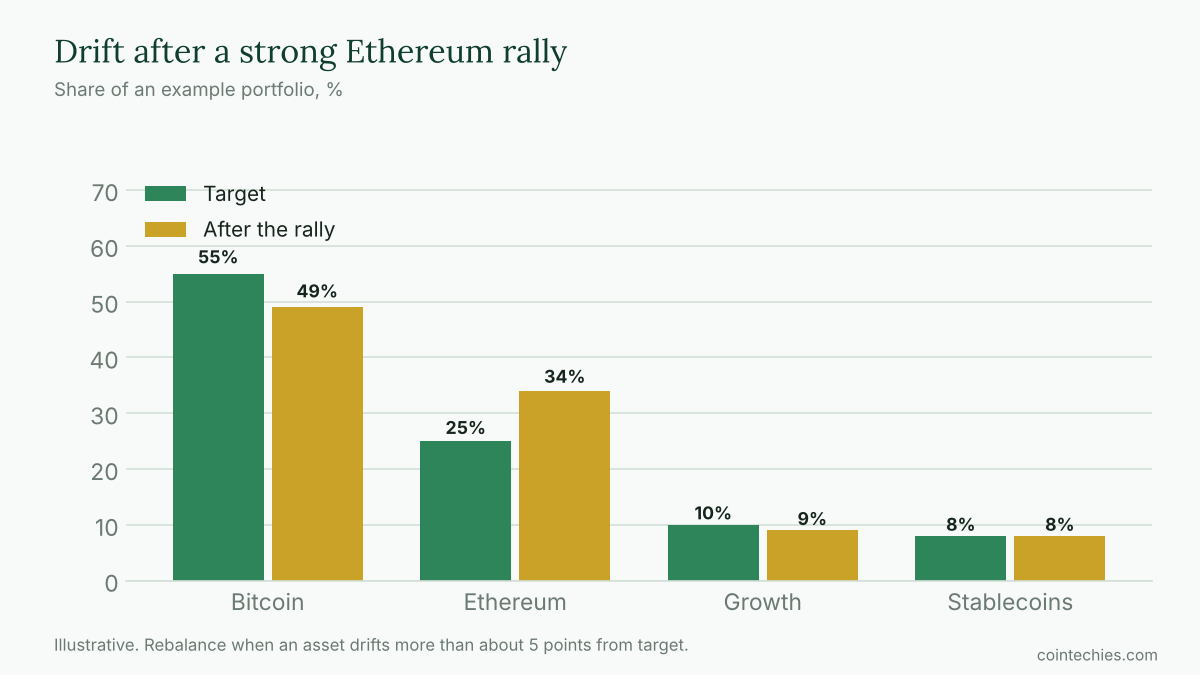
Prices change, and your portfolio will drift away from its targets. If one coin soars, it may become too large a share of the total, which raises your risk without you realising.
There are two simple approaches to rebalancing.
Calendar-based. Review at fixed intervals, say every six or twelve months, and adjust to your targets.
Threshold-based. Rebalance whenever an asset drifts more than a set amount from its target, for instance by five percentage points.
You can rebalance in two ways: sell a portion of the winners and buy the laggards, or direct new contributions into the underweight assets without selling anything. The second approach is simpler and avoids triggering taxes. If you do sell, keep in mind that the sale might create a taxable event in your country.
Rebalancing can feel uncomfortable, since you’re trimming what’s doing well. But it enforces discipline, locks in some gains and prevents a single hot asset from running your whole portfolio.
The bottom line
A balanced crypto portfolio isn’t about owning as many coins as possible. It’s about building layers: a strong base of the most established assets, a measured allocation to growth, a bit of cash-like stability and, if you want, a tiny sliver for speculation. Remember that crypto assets tend to move together, so real protection comes from sensible sizing and from diversifying beyond crypto too.
Start simple, keep it understandable and rebalance with discipline. A portfolio you can explain in two minutes and stick with for five years will almost always beat a clever one you abandon in the first crash.
This article is for educational purposes only and is not financial advice. The example portfolios are illustrations, not recommendations. Crypto assets are volatile and you can lose some or all of your investment.