« Is it too late to buy Bitcoin? » It might be the most-asked question in crypto, and it has been asked at nearly every price level since 2010. People asked it when Bitcoin cost a dollar. They asked it at $1,000, at $20,000, and again at $100,000.
The answer, every time, has been uncomfortable: nobody knows. Anyone who tells you with total confidence that Bitcoin is a bargain or a bubble is selling something, usually a course or a coin.
What we can do is lay out the strongest arguments on both sides, look at how the risks have changed, and give you a way of thinking that works whatever the price is doing on the day you read this. Think of it as a checklist rather than a prediction.
In this article
The case for buying
1. Scarcity is still built in
Bitcoin’s supply is capped at 21 million coins, and about 94% of them have already been mined. Every four years the rate of new issuance drops by half, a process we explain in our halving guide. Fewer new coins arriving each year means that, all else being equal, any increase in demand has a bigger effect on price.
Of course, « all else being equal » is doing heavy lifting there. Demand can fall as easily as rise. But the supply side of the equation is at least predictable.
2. The institutional on-ramps are open
Since spot Bitcoin ETFs launched in the United States in 2024, buying Bitcoin has become as easy as buying a share of a company. Pension managers, advisers and banks can now offer it without wrestling with wallets. This does not guarantee higher prices, but it removes a major barrier that held back large pools of money for years.
3. It has a track record of recovering
Bitcoin has suffered drops of 70% to 85% from peak to trough more than once. And each time, over a long enough window, it eventually reached new highs. Past performance proves nothing about the future, and there is no law saying the pattern must continue. Still, a decade and a half of surviving brutal crashes counts for something.
4. Many people want a hedge against money printing
If you worry about inflation or about governments expanding their balance sheets, Bitcoin offers an alternative store of value outside the traditional system. Whether it truly works as a hedge in the short run is debated, because it often trades like a risk asset. Over longer periods, supporters argue its fixed supply does the work.
A fair look at how crashes have played out
It helps to see Bitcoin’s volatility in context rather than as a vague fear. The big drawdowns have been severe, and they have also been followed by long recoveries.
The biggest falls from cycle highs were roughly 93% in 2011, 86% in 2013–15, 84% in 2017–18 and 77% in 2021–22. Figures are rounded and meant to give you a feel for the scale, not exact quotes.
Notice the trend. Each major drawdown has been slightly shallower than the one before, which is what you’d expect from a maturing market with more participants. But « shallower » still means losing more than half your money on paper. Be honest with yourself about whether you could sit through that.
The timing question: lump sum or drip?
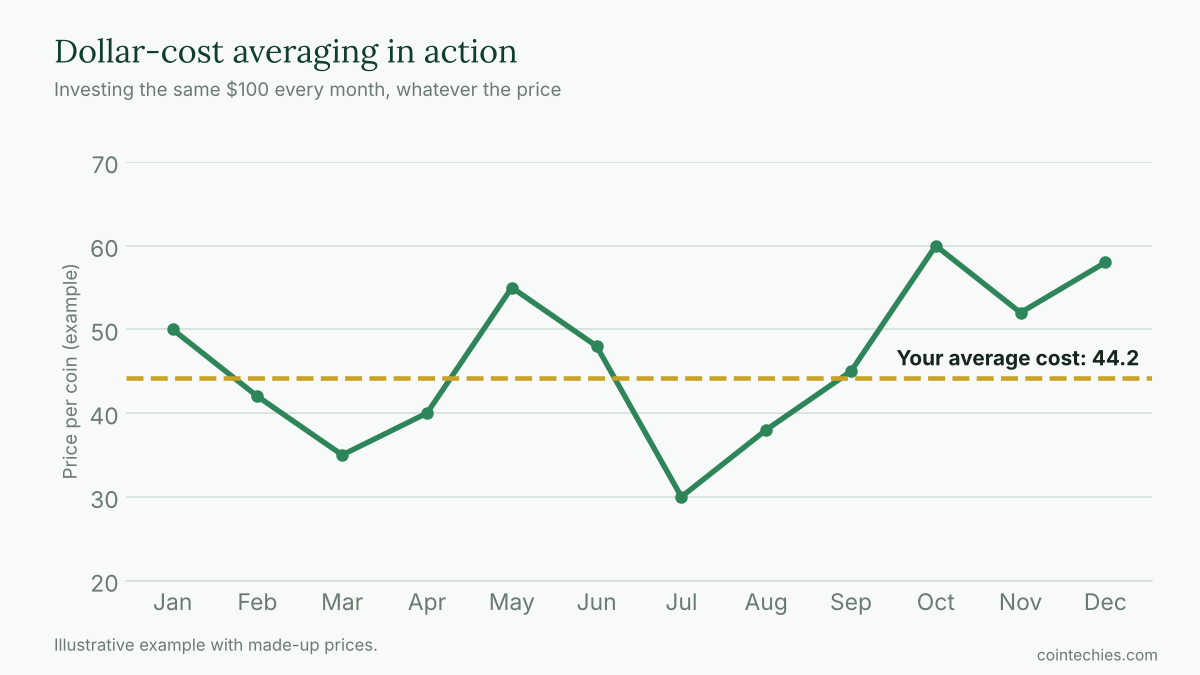
If you decide to buy, the next question is how. Trying to pick the bottom is a game most professionals lose. A calmer approach is dollar-cost averaging, usually shortened to DCA: you invest a fixed amount at regular intervals, say once a month, no matter what the price is doing.
Why it works for beginners:
- It removes the pressure of finding the perfect day.
- It smooths out your average purchase price over time.
- It builds a habit, which matters more than cleverness.
DCA doesn’t make you immune to losses. If the price keeps falling, you keep buying at lower prices and lose money on paper in the meantime. But it keeps emotions out of the driver’s seat, and that’s usually the biggest advantage.
A lump-sum purchase actually beats DCA more often than not in assets that rise over time, because money invested earlier has longer to grow. The trade-off is risk of regret. If you’d lose sleep over buying right before a drop, splitting your purchase over several months is a reasonable compromise.
So, is Bitcoin still worth buying in 2026?
Here’s the honest answer: for many people it can still be a reasonable, small part of a long-term plan, and for others it clearly isn’t the right fit. The deciding factors are your time horizon, your financial base and your tolerance for watching big red numbers.
If you do buy, the case for starting small, investing steadily and keeping your focus on years rather than days is stronger than any price prediction. Bitcoin’s story isn’t over, but it is no longer a free lunch. It’s a volatile, scarce, increasingly mainstream asset, and it rewards patience and punishes impulsiveness.
Before you decide, check the current Bitcoin price and treat what you see as one data point, not a verdict.
This article is for educational purposes only and is not financial advice. Consider your own circumstances and, if needed, speak to a qualified adviser. You can lose some or all of the money you invest in crypto assets.