
Every four years or so, the crypto world holds its breath. Countdown clocks appear on websites, social media fills with predictions and newcomers ask the same question: what exactly is happening, and should I be doing something about it?
The event is called the Bitcoin halving, and despite the drama around it, the concept is surprisingly simple. At fixed intervals, the amount of new bitcoin created with each block is cut in half. That’s it. No committee votes, no company decides. It’s a rule baked into Bitcoin’s code since day one.
Yet this small rule has big consequences for miners, for the long-term supply of the coin and, many people believe, for its price. In this guide, we’ll explain how it works from scratch, look at what happened after past halvings and separate the real effects from the myths.
In this article
What is the halving, exactly?
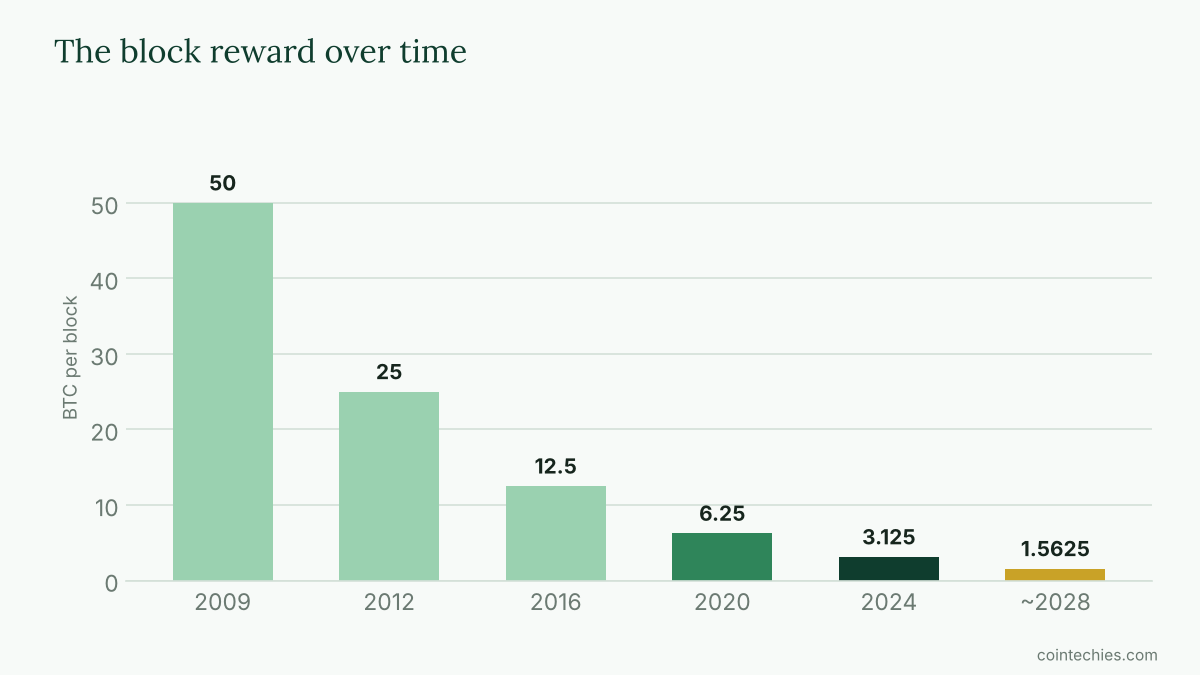
Bitcoin’s code says the block reward is cut in half every 210,000 blocks. At ten minutes per block, that works out to roughly four years.
It started at 50 bitcoin per block in 2009. Here’s how it has gone since:
- 2012: 50 → 25 BTC
- 2016: 25 → 12.5 BTC
- 2020: 12.5 → 6.25 BTC
- 2024: 6.25 → 3.125 BTC
- Around 2028: 3.125 → 1.5625 BTC
Each halving reduces the pace at which new coins enter circulation. Before the April 2024 halving, around 900 new bitcoin were created per day. Afterwards, it was roughly 450.
Why does the halving exist?
It’s the mechanism that makes Bitcoin’s supply predictable and finite. Because the reward keeps shrinking, the total number of coins approaches 21 million but never exceeds it. Satoshi Nakamoto, Bitcoin’s pseudonymous creator, designed it this way to mimic the scarcity of a precious metal, where finding more gets harder over time.
The schedule has another effect: it front-loads issuance. About half of all bitcoin were created in the first four years, and 90% by the 2020s. The last fraction will take more than a century to mine, with the final coin expected around the year 2140.
You can think of it as a gold rush where the nuggets get smaller every few years by design. Early miners got big rewards; later ones get less, and eventually, almost nothing but fees.
What happens to miners?
For miners, a halving is a sudden pay cut. Overnight, the revenue they receive from newly created coins falls by 50%, while their electricity bills and equipment costs stay the same.
What happens next depends on a few things:
- If the price of bitcoin rises enough, revenue recovers and mining remains profitable.
- If it doesn’t, the least efficient miners, those with old machines or expensive power, may be forced to shut down.
- Surviving miners often upgrade to more efficient equipment, which pushes the industry toward bigger, more professional operations.
This is called a miner shakeout, and it’s one of the reasons you may hear about network hash rate dipping briefly after a halving. In practice, Bitcoin’s overall computing power has tended to recover and climb to new highs over time, thanks to better chips and cheaper energy sources.
Transaction fees are the long-term plan. As the block subsidy shrinks, miners will rely more and more on fees paid by users to keep the network secure. Whether fee income will be enough decades from now is one of the major open questions about Bitcoin’s long-term design.
Is the halving really a « supply shock »?
A fair question: if the new supply is only a tiny fraction of the total, how big a deal can it be?
Right now, about 19.8 million bitcoin exist. Annual new issuance after the 2024 halving is under 1% of that, and in the next halving it will fall to below 0.5%. That’s a lower inflation rate than gold’s, which grows by around 1.5% to 2% a year.
So the shock is real but modest in size. It matters because it’s permanent, predictable and compounding: every halving makes the asset a bit scarcer in relation to demand than it was before.
What should a beginner actually do?
Let’s get practical. You’ve got a few sensible options and a few traps to avoid.
Do:
- Treat the halving as background information, not a signal to rush in.
- Keep your plan simple. If you invest regularly, for example monthly, a halving doesn’t need to change anything. Our beginner guide to investing in cryptocurrency explains how to set this up.
Don’t:
- Don’t borrow money to bet on the halving. Leverage and cycles are a recipe for forced selling.
- Don’t trust anyone who promises a specific price. Targets such as « to $X by date Y » are marketing, not analysis.
- Don’t buy a « halving token » or any product advertising the event. It is a common hook for scams.
The bottom line
The Bitcoin halving is a scheduled event that cuts the rate of new coin creation by half roughly every four years. It’s the engine behind Bitcoin’s famous 21 million cap, a squeeze on miners’ income and a regular source of excitement in the crypto calendar.
Does it move the price? Probably it plays a role over the long run through increasing scarcity, but it is only one of many forces, and every cycle has looked different. For beginners, the best response is the simplest: understand it, appreciate what it says about Bitcoin’s design, and avoid making rash decisions because of a countdown timer.
Keep reading: see whether Bitcoin is still worth buying in 2026 and why it is the king of crypto.
This article is for educational purposes only and is not financial advice. Past performance is not a guide to future results. Crypto assets are volatile and you can lose some or all of your investment.