Picture two vaults. One is made of steel and sits under a city centre. Inside are gold bars you can touch, weigh and, in theory, melt down for jewellery. The other vault is a string of 12 or 24 words written on a piece of paper in your desk drawer. Inside it is Bitcoin.
Both are often described as stores of value, assets people buy to protect their wealth rather than to earn a salary-like income. Gold has played that role for roughly five thousand years. Bitcoin has been trying for about fifteen.
So which one deserves a place in your long-term portfolio? The honest answer is that they do different jobs, and the better choice depends on what you need. In this guide we’ll compare them head to head, in everyday language, and then show how some investors combine them.
In this article
Round 1: scarcity
Gold is scarce, but not capped. Miners dig up around 3,000 tonnes a year, adding roughly 1.5% to 2% to the total stock above ground. If the price rises enough, more mines become profitable and supply increases. There’s also the unknown: asteroids aside, nobody can rule out new discoveries.
Bitcoin’s supply is capped at 21 million, and its yearly issuance is now under 1% of the existing supply and shrinking. After each halving, the new supply drops by half. In a decade or so, it will be close to zero.
Edge: Bitcoin. Its scarcity is absolute and verifiable. Gold’s is strong but flexible.
Round 3: size and stability
Gold’s total value is estimated at tens of trillions of dollars, making it one of the largest assets on the planet. Bitcoin’s market value is measured in the low trillions. Size matters because a bigger market is harder to move: a large order will not shake gold’s price much, while a few big buyers or sellers can swing Bitcoin.
Volatility tells the same story. Gold typically moves about as much as a stock index, with annual swings in the range of 10% to 20%. Bitcoin’s annual swings have often been three to four times larger. That’s the price of being young and smaller.
Think of volatility as the amount of bumpiness on the road. Bitcoin offers the potential for a faster journey, but you’ll feel every pothole.
Edge: Gold. Stability is its strength.
How have they behaved in practice?
Over short windows, the two don’t move in lockstep. Gold tends to rise when investors are scared: during geopolitical shocks or when real interest rates fall. Bitcoin has sometimes acted similarly, but at other times it has sold off alongside stocks.
Over longer periods, Bitcoin’s returns have been much larger than gold’s, driven by its growth from nothing to a trillion-dollar asset. That is the head start of a tiny asset becoming bigger, and it’s not likely to be repeated at the same scale. A reasonable investor should expect Bitcoin’s future returns to be lower than its past ones, though possibly still higher than gold’s, with considerably more risk.
Gold, for its part, has had stretches of more than a decade with no gains in real terms. It’s not a magic shield. It protects against specific problems, such as currency debasement and crises of trust, rather than guaranteeing profit.
Can you own both?
Many investors do, and it’s a legitimate strategy rather than a cop-out. The two assets don’t depend on exactly the same forces. Gold leans on a very old, very stable demand base. Bitcoin leans on a young, fast-growing network. Holding both gives you exposure to two separate answers to the question « what’s a reliable store of value? »
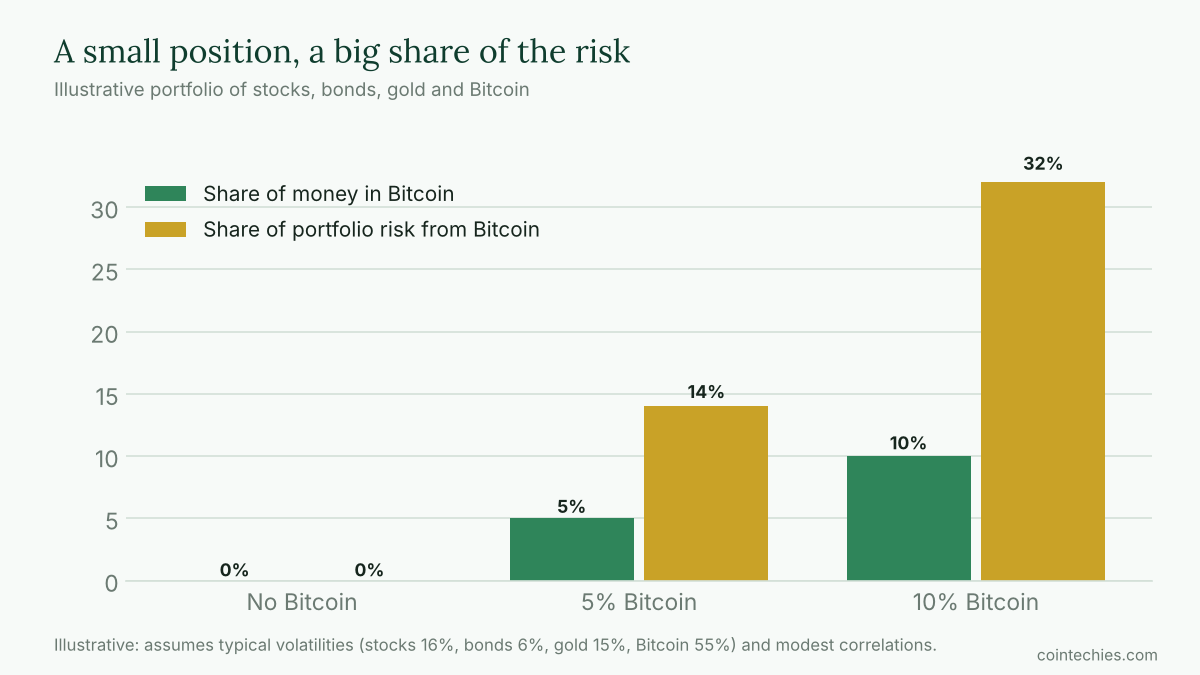
The more Bitcoin you add, the more of the portfolio’s risk comes from that single asset, even if its share of your money looks small. A 5% Bitcoin position can contribute far more than 5% of your portfolio’s ups and downs. We dig deeper into position sizing in our guide on how much money to invest in Bitcoin, and into mixing assets in how to build a balanced cryptocurrency portfolio.
The verdict
If you made us pick one for a cautious, long-term investor who wants stability above everything else, we’d say gold. It’s proven, liquid and calm.
If you asked for the asset with the larger potential upside over a decade, and you have the stomach and the time, Bitcoin is the more exciting candidate, with a long list of risks attached.
And if you want our practical view: they aren’t enemies. They are two tools for different problems. A small Bitcoin position beside a core of traditional assets, perhaps with some gold, is a sensible way to take part without betting the farm.
Whatever you choose, take it slow, keep your emergency fund separate, and judge your decisions by how well they fit your life rather than by how well they would have done in somebody else’s.
This article is for educational purposes only and is not financial advice. Prices and market sizes change quickly, so check current data before making decisions. Crypto assets are volatile and you can lose some or all of your investment.