Every few months, someone announces the Bitcoin killer. A faster chain, a cheaper chain, a smarter chain with a flashier logo. And every few months, Bitcoin shrugs, prints another block roughly ten minutes later, and carries on as if nothing happened.
It’s a strange kind of dominance. Bitcoin is not the fastest network, it is not the most flexible, and it has no CEO to promote it on stage. Still, when markets wobble, traders watch Bitcoin first. When big institutions dip a toe into crypto, they start with Bitcoin. When a government debates how to regulate digital assets, Bitcoin is the example on the table.
So why does the oldest cryptocurrency still wear the crown? In this guide we’ll walk through the real reasons, in plain English and without the hype. We’ll look at what makes Bitcoin different, where it is weak, and what could actually threaten its position.
In this article
Scarcity you can actually verify
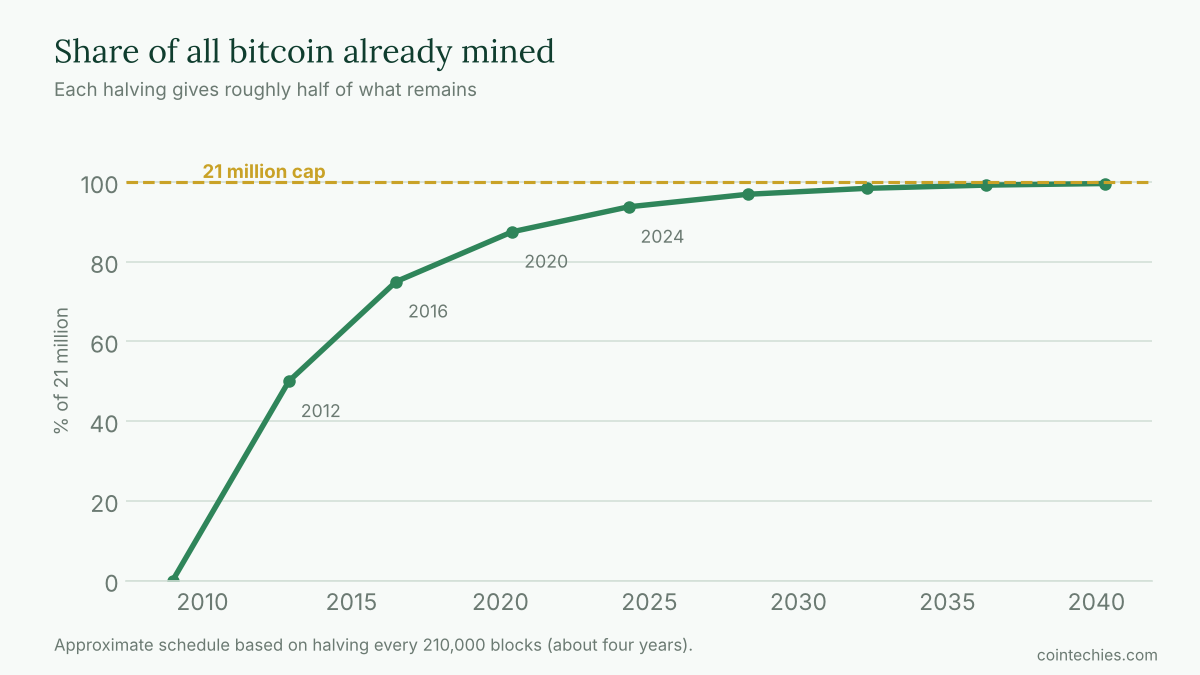
The strongest part of Bitcoin’s pitch is its supply. The protocol allows only 21 million coins to exist, ever. Roughly 19.8 million have already been mined, and the rest will trickle out slowly until around the year 2140.
Compare that to traditional money. Central banks can expand the money supply when they judge it necessary, which can be useful in a crisis but also erodes purchasing power over long periods. Bitcoin’s schedule is written in code, and every participant on the network can verify it independently.
This is why people call Bitcoin « digital gold. » Gold is scarce because nature made it hard to find. Bitcoin is scarce because mathematics makes it impossible to create more. The difference is that you can check Bitcoin’s supply yourself in seconds, while gold’s total quantity is an estimate.
We’ll compare the two more closely in our guide on Bitcoin vs gold, but the key takeaway here is simple: predictable, fixed scarcity is rare in finance, and Bitcoin was the first asset to offer it digitally.
Decentralisation: the feature that is hard to copy
Plenty of projects claim to be decentralised. Bitcoin is the one where the claim holds up best.
Thousands of independent nodes around the world run the software and check every transaction against the rules. Miners compete to add new blocks, and the ones who cheat get their work rejected. No company can switch the network off, and no single government can change the rules by decree.
There is also a cultural side. Bitcoin’s developers are famously conservative. Changes happen slowly, after long public debate, and the bar for altering core rules is very high. That frustrates people who want new features quickly, but it is exactly what lets others trust that the 21 million cap will not quietly be changed.
Think of it as a trade-off. Many newer blockchains choose speed and flexibility. Bitcoin chooses predictability. For something meant to store value over many years, predictability is the whole point.
What Bitcoin is not good at
Calling Bitcoin the king does not mean it’s perfect. Being honest about the weaknesses is what separates analysis from cheerleading.
It is slow for everyday payments. The base layer processes only a handful of transactions per second, and fees rise when demand is high. Second-layer systems such as the Lightning Network aim to fix this by handling small payments off the main chain, and they have made real progress, but mainstream shopping with Bitcoin is still uncommon.
It is volatile. Drops of 50% or more have happened several times. A currency that can lose half its value in a few months is hard to use for budgeting, and even as an investment it demands a strong stomach.
It is not very programmable. Bitcoin can do simple scripts, but it was never designed for the complex applications that run on networks like Ethereum. If you want lending protocols, tokenised assets or on-chain games, you look elsewhere. We explore that world in our piece on why Ethereum’s ecosystem matters.
Custody is on you. Lose your keys and nobody can reset your password. That’s empowering for some people and terrifying for others.
None of these weaknesses has dethroned Bitcoin so far, because they trade against its strengths. A system optimised for security and scarcity is not going to also be the cheapest and fastest at everything.
The bottom line
Bitcoin remains the king of cryptocurrencies for a mix of reasons that reinforce each other: it came first, it has a fixed supply that anyone can verify, it is more decentralised than almost anything else in the space, it has survived more than fifteen years of stress tests, and the world’s largest financial institutions now treat it as the default entry point to the asset class.
That doesn’t make it risk-free or guarantee future returns. It will keep swinging wildly, and nobody can promise where the price goes next. But as a piece of technology and as a monetary experiment, it has earned its place at the top of the table.
The smartest way to treat a king is neither to worship it nor to dismiss it. Understand it, size your position sensibly, and keep learning.
Keep reading: see whether Bitcoin is still worth buying in 2026 or follow the live Bitcoin price.
This article is for educational purposes only and is not financial advice. Crypto assets are volatile and you can lose some or all of your investment.