If Bitcoin is digital gold, Ethereum is closer to a digital city. Gold sits in a vault and does one thing very well. A city is full of shops, banks, workshops, games, post offices and people who built things on top of each other over years.
That image helps explain a puzzle. On paper, Ethereum looks beatable. Newer blockchains process more transactions per second, charge lower fees and market themselves loudly. And yet, when a big company wants to put a stablecoin on a blockchain, or a developer wants to launch a lending app, or an asset manager wants to tokenise a fund, the first stop is usually still Ethereum.
Why does that happen? In this guide we’ll explain what makes Ethereum’s ecosystem sticky, how it has solved some of its own weaknesses, and what to watch if you’re trying to understand its long-term role.
In this article
From « world computer » to world’s busiest app platform
Ethereum went live in July 2015, proposed by a then-teenage programmer named Vitalik Buterin and built by a team of co-founders. Its big idea was a blockchain that does more than move coins. It can also run small programs called smart contracts.
A smart contract is just code that lives on the blockchain and executes automatically when conditions are met. Think of a vending machine: you put in money, press a button, and the machine delivers a snack without a shopkeeper. A smart contract does the same with financial agreements.
Once the code is on the network, nobody can quietly change it or switch it off, and anyone can use it. That opens up remarkable possibilities: lending without a bank, trading without an exchange operator, ownership records without a registry. It also opens up remarkable risks, because bugs in code can’t be undone with a phone call.
The Merge: Ethereum changed its engine mid-flight
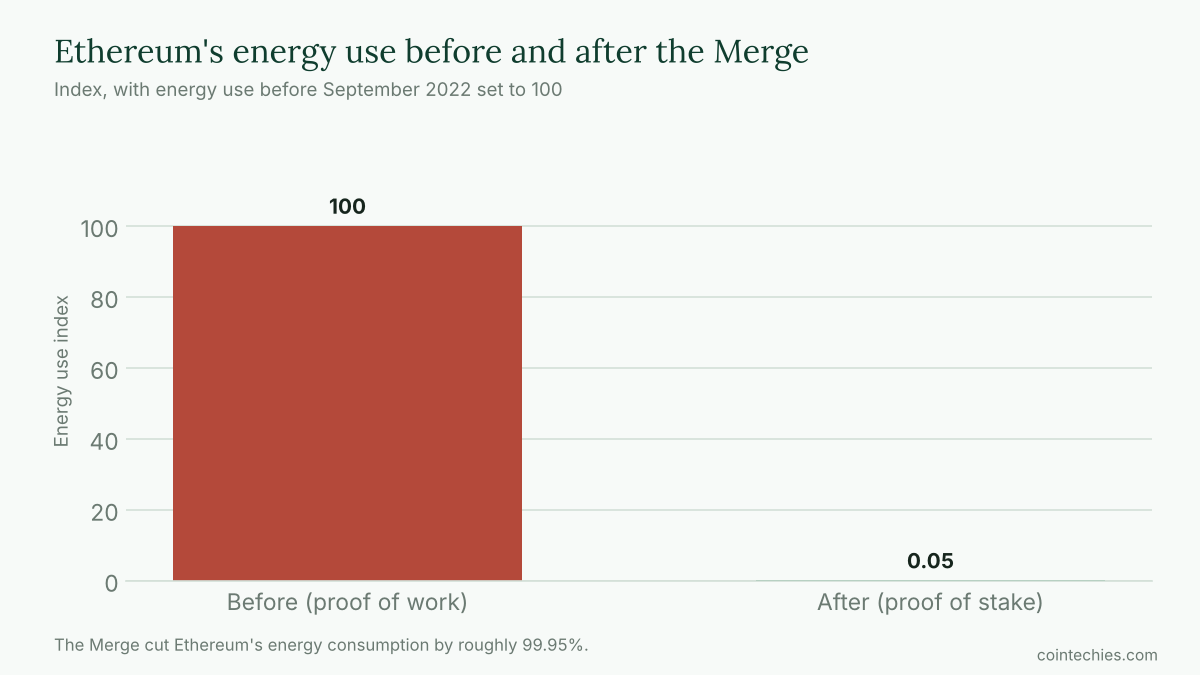
In September 2022, Ethereum completed a long-promised upgrade known as the Merge. It switched from proof of work, where miners burn electricity to secure the network, to proof of stake, where validators lock up ETH as a guarantee of honest behaviour.
The result was dramatic. The network’s energy consumption dropped by roughly 99.95%. That was important for two reasons: it answered the most common environmental criticism, and it demonstrated that a huge, live blockchain could change its core machinery without stopping. Few projects of that scale have pulled off something comparable.
Proof of stake also changed ETH as an asset. People who stake their ETH can earn a yield, usually a few percent a year, which makes it closer to an interest-bearing asset than Bitcoin. A meaningful share of all ETH is now staked.
Alongside a fee-burning mechanism introduced in 2021, which destroys part of the fees paid by users, issuance of new ETH has been low, and at times turned negative when activity was high. This doesn’t give ETH a fixed supply like Bitcoin, but it makes its supply policy far tighter than in its early years.
Layer 2s: fixing fees without leaving home
The biggest knock against Ethereum has always been cost. At the main layer, when the network is busy, a simple transaction could cost many dollars. For a small payment or a game, that’s absurd.
Ethereum’s answer is not to make the base layer do everything, but to add a second tier. Layer 2 networks, such as Arbitrum, Optimism, Base and others, process transactions in bulk and then post compressed proofs back to Ethereum. They inherit its security while being much faster and cheaper.
An upgrade in March 2024, called Dencun, introduced a cheaper way for these networks to post their data, cutting their fees dramatically. Costs for using layer 2s dropped to cents or less for many actions.
Think of it like a motorway system. The main highway, Ethereum, is where long-distance, heavy traffic settles. Layer 2s are the local roads that handle the daily commute. Both are needed.
This strategy has trade-offs. Liquidity and users are now spread across many layer 2 networks, which can make the experience feel fragmented. Moving money between them takes some know-how. Teams across the ecosystem are working on smoother connections, but it’s an area where Ethereum’s rivals, with single unified chains, can feel simpler.
The bottom line
Ethereum’s ecosystem remains important because it has what is hardest to replicate in technology: a thriving community of builders, a library of shared standards, deep pools of money and years of proof that it can stay online and evolve.
It isn’t the cheapest or the quickest, and it faces real rivals. Yet for now, if crypto were a city, most of its main streets, banks and marketplaces would still be built on Ethereum’s ground. That doesn’t guarantee its future, but it explains why so many people still choose to build there.
Keep reading: compare it with Ethereum vs Solana or follow the live Ethereum price.
This article is for educational purposes only and is not financial advice. Crypto assets are volatile and you can lose some or all of your investment.