Ask crypto fans to pick between Ethereum and Solana and you will get an answer that sounds more like a football allegiance than an analysis. Ethereum people talk about security, decentralisation and a decade of proven resilience. Solana people talk about speed, tiny fees and apps that feel like the normal internet.
Both camps are partly right, and that’s what makes the comparison interesting. These two networks are built on different philosophies, they solve different problems in different ways, and they’re competing for the same developers and users.
So which one has the stronger future? We can’t predict the winner, and anyone who claims to is guessing. What we can do is break down how each works, where each is strong, where each is vulnerable, and what would have to happen for either to pull ahead. By the end, you’ll have a framework you can use whatever the price charts say this week.
In this article
Two philosophies
The fundamental difference isn’t speed. It’s how each network thinks about scaling.
Ethereum is modular. The base layer focuses on security and decentralisation, and the heavy lifting of fast, cheap transactions is passed to layer 2 networks built on top. The base layer acts as a court of final settlement, while other chains do the day-to-day work.
Solana is monolithic. Everything happens on one chain, and the goal is to make that one chain as fast as possible. Developers and users get a single, unified environment where all apps share the same state and liquidity.
Neither approach is inherently superior. The modular route can be more secure and flexible but more fragmented. The monolithic route feels simpler and quicker but demands powerful hardware and relies on getting the engineering exactly right.
Speed and fees: Solana’s headline advantage
Let’s start with what users notice first.
On Ethereum’s main layer, a new block arrives about every 12 seconds, and fees depend on demand. When things are quiet they can be pennies; when things are busy they’ve spiked to tens of dollars. Layer 2 networks lower costs to cents or fractions of cents, but you’ll need to bridge your money there first.
On Solana, blocks are produced in a fraction of a second, and fees are typically a tiny fraction of a cent. For tasks like trading, gaming or sending small payments, that feels like a different world.
In everyday terms: Solana feels like tapping a card at a shop. Ethereum’s base layer feels like sending a wire transfer. Ethereum’s layer 2s narrow the gap a lot, but they add a step.
Edge: Solana for raw speed and simplicity.
Developers and ecosystem size
Ethereum has the largest developer community in crypto, the most battle-tested code and the deepest pools of capital, especially in DeFi and tokenised real-world assets. When established companies want to experiment, they usually begin there.
Solana has built an enthusiastic community of its own and has been among the fastest-growing ecosystems for new developers. Its apps cover trading, payments, gaming and a vibrant culture of community tokens, including a wave of memecoins that brought huge attention, along with the risks that come with speculative frenzy. Solana’s programming language, Rust, has a steeper learning curve than Ethereum’s Solidity for some developers, but it’s well regarded for performance.
Mainstream brands have also started to explore Solana for payments and loyalty programmes, attracted by low fees. And in the United States, investment funds linked to SOL have started to appear, a milestone Ethereum reached earlier but a significant step for a younger network.
Edge: Ethereum for depth, Solana for momentum in consumer-style apps.
Who is each network best for?
Here’s a quick way to match the network to the purpose.
- A big financial institution tokenising a fund: Ethereum, for trust and legal familiarity.
- A developer building a high-frequency trading app: Solana, for speed and low cost.
- A user who just wants to send small payments or play a game: Solana, or an Ethereum layer 2.
- Someone wanting maximum censorship resistance: Ethereum.
The verdict
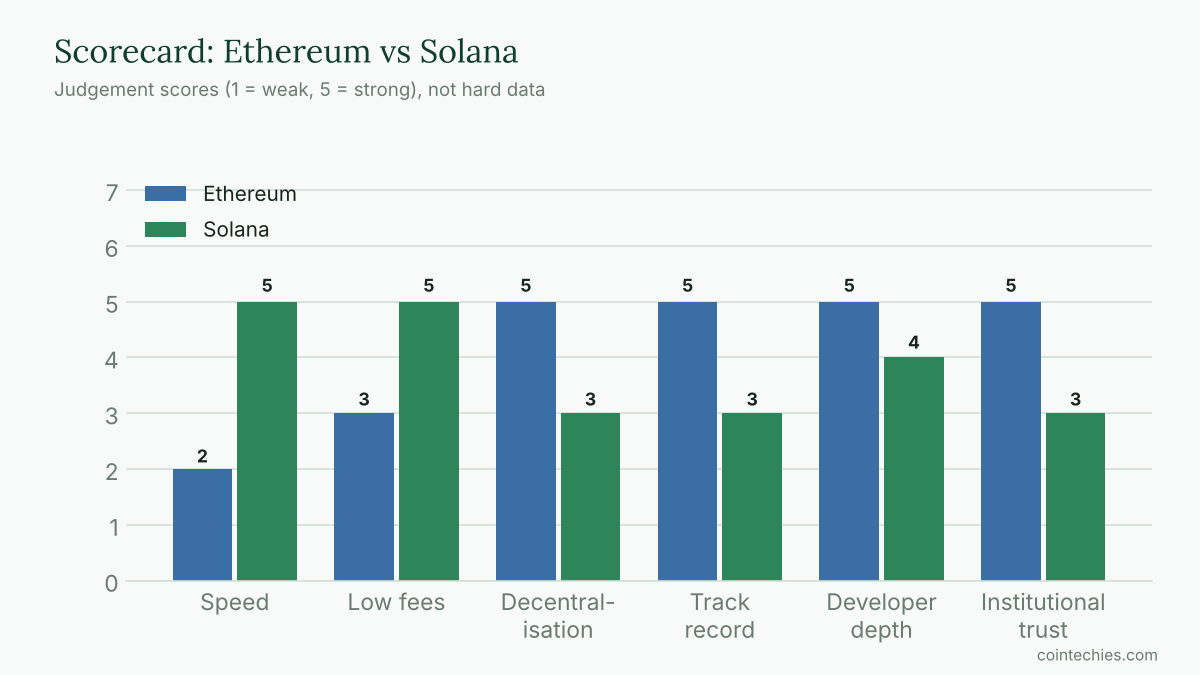
If you measure the future by security, institutional trust and ecosystem depth, Ethereum holds the stronger hand today. If you measure it by user experience, speed and pace of growth in consumer apps, Solana looks more compelling.
The honest answer is that « strongest future » depends on which problems the world wants blockchains to solve first. If the answer is high-value settlement and tokenised finance, Ethereum is better placed. If it’s fast, cheap, everyday applications, Solana has a real shot at leading.
For most people, the practical approach isn’t to bet everything on one side. Watch the data, from user activity to uptime to developer growth, keep your positions modest, and stay open to the possibility that both could succeed in different ways.
Keep reading: learn why Ethereum’s ecosystem matters or follow the live Solana price.
This article is for educational purposes only and is not financial advice. Crypto assets are volatile and you can lose some or all of your investment.