Two people buy the same amount of Bitcoin on the same day. One of them locks the screen and goes on with life. The other sets up charts, alerts and a dozen browser tabs, and starts trading in and out several times a week.
A year later, who’s ahead? It depends, and that’s exactly why this debate never ends. Crypto’s wild price swings make trading look like a goldmine. They also make buy-and-hold look like a masterstroke. Social media is full of screenshots showing both.
The truth is more nuanced and less glamorous. In this article, we’ll compare crypto trading and long-term investing on the things that matter: time, skill, cost, tax, stress and results. We’ll also show how many people mix the two sensibly, and how to decide which approach suits you.
In this article
Two different games
It helps to see trading and investing as distinct activities, not just faster and slower versions of the same thing.
Long-term investing means buying assets you believe will grow in value over years, then holding through the ups and downs. In crypto, it’s often called « HODLing », a typo that became a battle cry. The investor’s edge is patience and a belief in the asset’s long-term story.
Trading means profiting from price movements over shorter periods, from minutes to a few weeks. Traders may use technical analysis, news, chart patterns or algorithms. They’re not trying to own the asset for its long-term story; they’re trying to be right about the next move.
Day traders open and close positions within a day, swing traders hold for days or weeks, and scalpers hunt for tiny moves many times an hour. The shorter the time frame, the more it resembles a full-time job with high stress.
The case for long-term investing
It’s simpler
You pick a few assets, decide how much to buy, set up regular purchases and then step away. No need to watch charts at midnight.
Costs stay low
Every trade comes with fees and, often, a spread, the gap between the buying and selling price. Investors who trade rarely pay far less over time.
It captures big moves
Crypto’s best days are often unpredictable and clustered. Missing just a handful of the strongest days can drag long-term returns down drastically. Investors who stay in the market are there when they happen.
Taxes are often kinder
In many countries, assets held for longer than a certain period, often a year, are taxed at lower rates than short-term gains. Frequent trading usually creates many taxable events, and the paperwork can become a nightmare. Check the rules where you live.
It matches how wealth is usually built
Most lasting wealth comes from owning productive or scarce assets for a long time, not from perfect timing.
What the evidence says
This is where we need to be blunt. When researchers have analysed what happens to retail traders, the results are sobering.
Studies of day traders in stock markets have repeatedly found that the vast majority lose money over time, and only a tiny fraction earn consistent profits after costs. A widely cited study of Brazilian day traders found that most who persisted for hundreds of days still lost money.
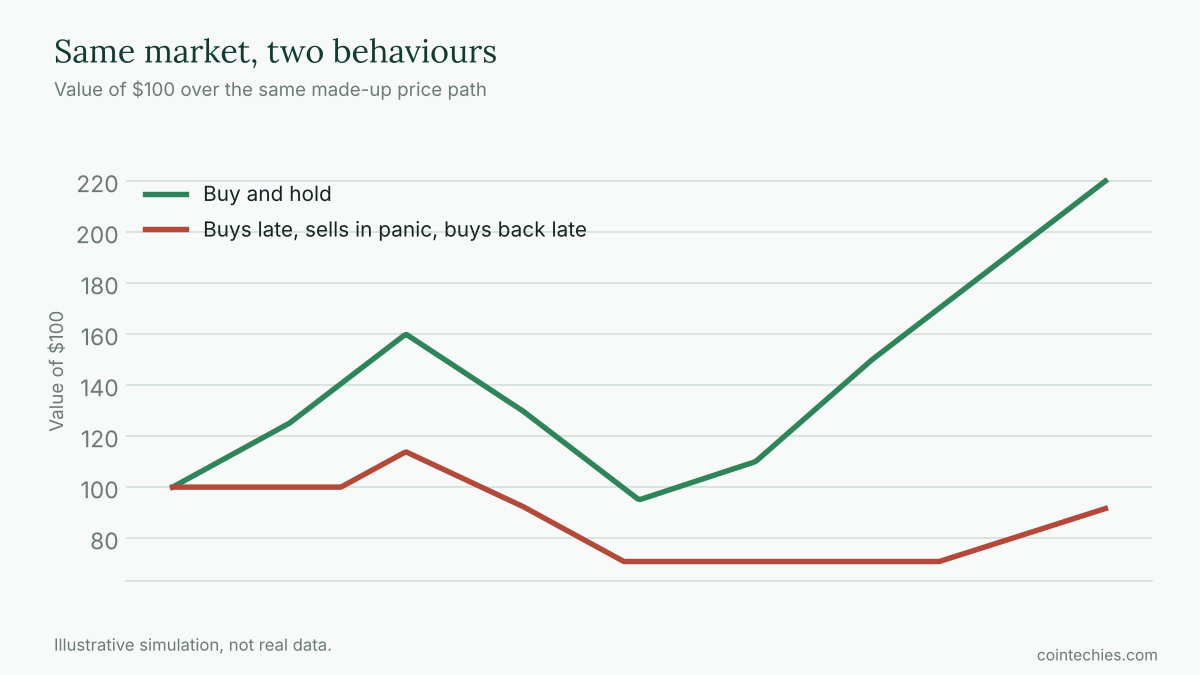
Crypto looks similar, or worse. A 2023 analysis by the Bank for International Settlements, a body that works with central banks, estimated that a majority of retail investors using crypto apps had likely lost money on their Bitcoin investments, largely because they bought during price surges and sold during sell-offs. Leverage makes it worse, since a small adverse move can wipe out an entire position.
This doesn’t mean no one can trade successfully. Professionals exist, and some retail traders do well. But the odds against the average person, who is competing with institutions, algorithms and market makers, are steep.
The hidden cost of trading: friction
Even before we consider skill, trading carries a built-in handicap in the form of fees, spreads and taxes. Each round trip, meaning a buy and a sell, may cost around half a percent or more once everything is included. That might sound small. Multiply it by hundreds of trades and the effect becomes enormous.
Suppose each round trip costs 0.6% in fees and spreads. If you made 10 round trips in a year, you’d lose around 6% of your capital to costs before you’ve earned a cent. At 50 trades, you’d be down a quarter. At 200, costs alone would consume most of your account. A trader has to beat the market by more than that just to break even.
A buy-and-hold investor pays these costs once or twice.
The bottom line
So which is better? For the large majority of people, long-term investing is the better strategy: it costs less, takes less time, produces fewer emotional mistakes and doesn’t require beating professionals at their own game. Trading can work for a small number of disciplined, well-resourced people, but even they usually treat it as a skilled profession, not a shortcut.
The best strategy is the one you can stick to. If you can stay calm and consistent, a simple long-term plan gives you the greatest chance of benefiting from crypto’s growth. If you can’t resist the thrill of the chase, contain it in a small, separate pot, and keep the rest safe.
Keep reading: how to start investing in cryptocurrency and the 10 mistakes beginners should avoid.
This article is for educational purposes only and is not financial advice. Trading, especially with leverage, carries a high risk of loss. Crypto assets are volatile and you can lose some or all of your investment.