
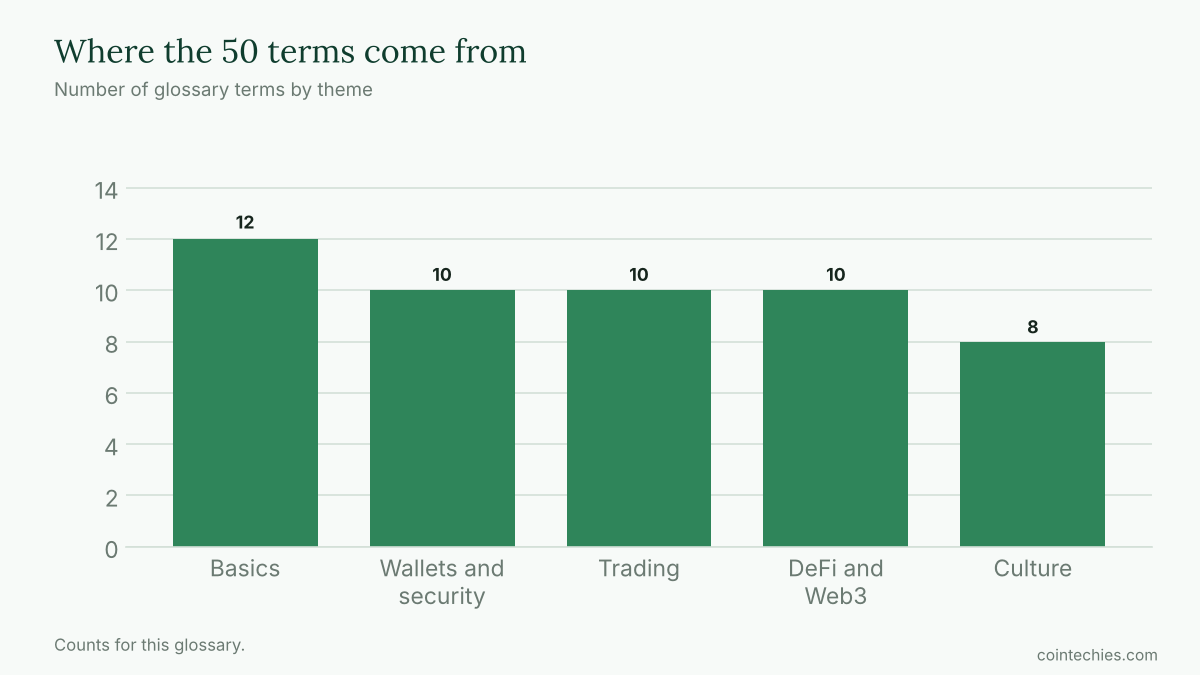
Crypto can feel like a foreign language. This glossary covers 50 terms you will meet again and again, grouped by theme so you can read it in one go or come back later.
In this article
Basics
- Altcoin: any cryptocurrency other than Bitcoin.
- Blockchain: a shared record of transactions kept by many computers.
- Coin: a cryptocurrency with its own blockchain.
- Token: a digital asset built on another blockchain.
- Stablecoin: a coin designed to hold a steady value, such as one dollar.
- Market cap: price multiplied by the number of coins in circulation.
- Halving: the cut of Bitcoin’s mining reward by half, about every four years.
- Fork: a change in a blockchain’s rules, sometimes creating a new coin.
- Node: a computer that stores and checks a copy of the blockchain.
- Mining: using computing power to validate transactions on proof-of-work chains.
- Staking: locking coins to help secure a proof-of-stake network and earn rewards.
- Satoshi: the smallest unit of Bitcoin, one hundred-millionth of a coin.
Wallets and security
- Wallet: an app or device that stores your keys.
- Private key: the secret that lets you spend your coins.
- Public address: where others can send you crypto.
- Seed phrase: a list of words that restores your wallet.
- Hot wallet: connected to the internet, convenient but more exposed.
- Cold wallet: kept offline for safer storage.
- Hardware wallet: a physical device that stores keys offline.
- Custody: who holds the keys, you or an exchange.
- Two-factor authentication: a second step, such as an app code, when you log in.
- Phishing: a trick to steal your details with fake messages or sites.
Trading
- Exchange: a marketplace to buy and sell crypto.
- Order book: the list of buy and sell orders.
- Market order: buy or sell immediately at the current price.
- Limit order: buy or sell only at a price you choose.
- Spread: the gap between the best buy and sell prices.
- Liquidity: how easily an asset can be traded without moving the price.
- Volume: the amount traded in a given period.
- Slippage: the difference between the expected and the actual price.
- Leverage: borrowing to trade a bigger position, which magnifies losses too.
- Bull and bear market: a rising or falling market.
DeFi and Web3
- DeFi: decentralised finance, financial services run by code.
- Smart contract: a program on a blockchain that runs automatically.
- DApp: an app built on a blockchain.
- Gas: the fee for using a blockchain such as Ethereum.
- Layer 2: a network built on top of another to make it faster and cheaper.
- DEX: a decentralised exchange.
- Liquidity pool: funds locked in a contract to enable trading.
- Yield farming: moving funds between protocols to earn rewards.
- NFT: a unique digital item recorded on a blockchain.
- DAO: an organisation governed by token holders.
Culture
- HODL: hold on, a famous typo for hold.
- FOMO: fear of missing out.
- FUD: fear, uncertainty and doubt.
- Whale: someone holding a very large amount.
- Rug pull: developers abandon a project and take investors’ money.
- ATH: all-time high.
- DYOR: do your own research.
- Airdrop: free tokens sent to wallets.
The bottom line
You do not need to memorise everything. Bookmark this page, learn the terms as you meet them and soon the language will feel natural.
This article is for educational purposes only and is not financial advice. Crypto assets are volatile and you can lose some or all of your investment.
Laisser un commentaire