Trading looks exciting. Charts move, screens flash and social media is full of big wins. But for most beginners the reality is different. Here is how to approach it with open eyes.
In this article
Trading is not investing
Investing means holding assets for years. Trading means profiting from price moves over minutes, days or weeks. It demands time, skill and discipline, and studies of retail traders consistently show that most lose money after costs.
Learn the basics first
- Exchange: where you place orders.
- Market order: buys or sells instantly at the current price.
- Limit order: buys or sells only at your chosen price.
- Stop order: triggers when the price reaches a level, often used to limit losses.
- Spot trading: buying the actual coin, with no borrowing.
Count the costs
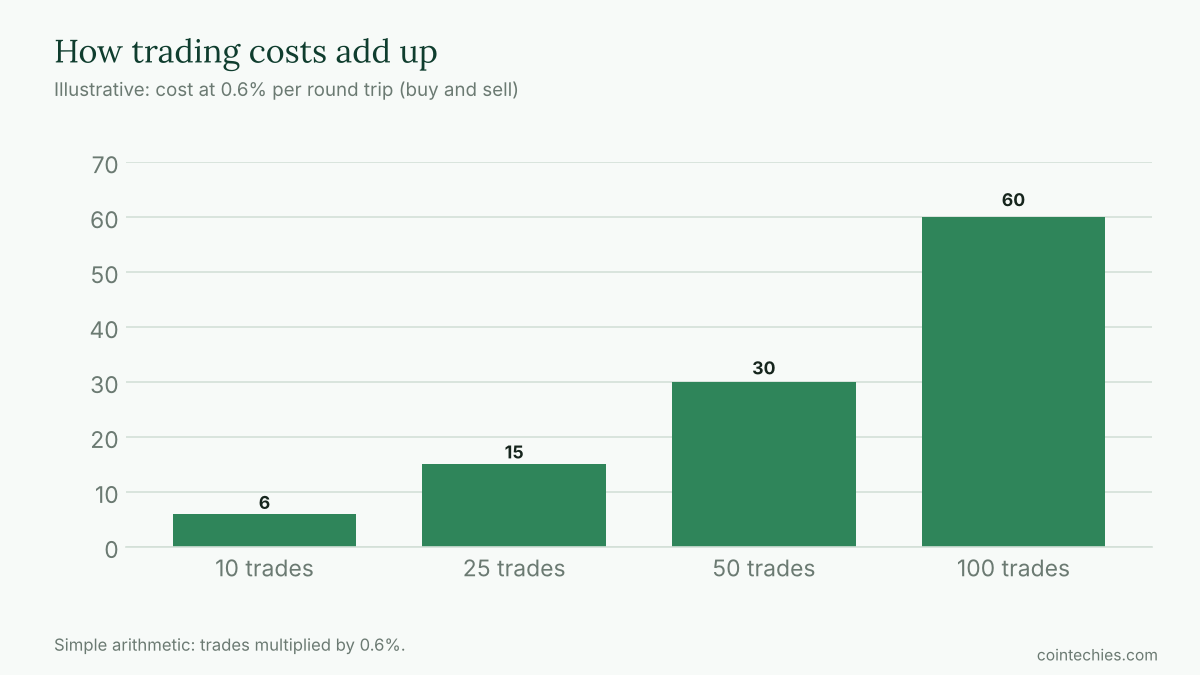
Every trade has a fee, and a spread between buying and selling prices. These costs look small but add up with each trade. At 0.6% per round trip, 100 trades could consume about 60% of your starting capital.
Start with a plan
Before any trade, write down why you are entering, where you will exit if wrong and where you will take profit. Decide how much you will risk, commonly a small percentage of your trading capital per trade, such as 1%.
Risk management basics
- Use stop-losses to cap the damage of a bad trade.
- Size positions small so no single trade hurts.
- Avoid leverage as a beginner: it magnifies losses and can wipe out an account quickly.
- Separate your trading money from your long-term savings.
Practise first
Many platforms offer demo accounts with fake money. Use one for several weeks. It is a cheap way to learn the interface and test strategies.
Keep a trading journal
Record each trade’s reason, entry, exit and what you felt. Patterns in your mistakes will appear, and fixing them improves results more than any indicator.
Mind the emotions
Fear and greed drive many poor decisions: chasing pumps, holding losers too long, revenge trading after a loss. Rules written in advance are your best protection.
The bottom line
Start small, learn on a demo account, keep costs low, risk little per trade and be honest about results. Many people discover that a simple long-term plan serves them better, and that is perfectly fine.
This article is for educational purposes only and is not financial advice. Trading, especially with leverage, carries a high risk of loss. Crypto assets are volatile and you can lose some or all of your investment.
Laisser un commentaire