When you want to swap one crypto for another, you can go through a company or straight through code. These two routes are called centralised and decentralised exchanges. Each suits different people.
In this article
Centralised exchanges (CEX)
A centralised exchange is a company that runs a platform, matches buyers with sellers and usually holds your funds in custody. Well-known examples include Coinbase, Kraken and Binance.
Pros: easy sign-up, simple apps, bank and card payments, customer support and often insurance or regulation.
Cons: you must verify your identity, and you do not control your keys. If the company fails, gets hacked or freezes withdrawals, you could be affected. The collapse of FTX in 2022 showed this risk clearly.
Decentralised exchanges (DEX)
A decentralised exchange is a set of smart contracts. You connect your own wallet and swap tokens directly, with prices set by liquidity pools rather than an order book. Uniswap is a well-known example.
Pros: you keep control of your coins, usually no sign-up or ID, and access to a huge range of tokens, including new ones.
Cons: you take on more responsibility. Mistakes are permanent, interfaces can be confusing, network fees apply and fake tokens are common. There is no support desk to call.
Key differences
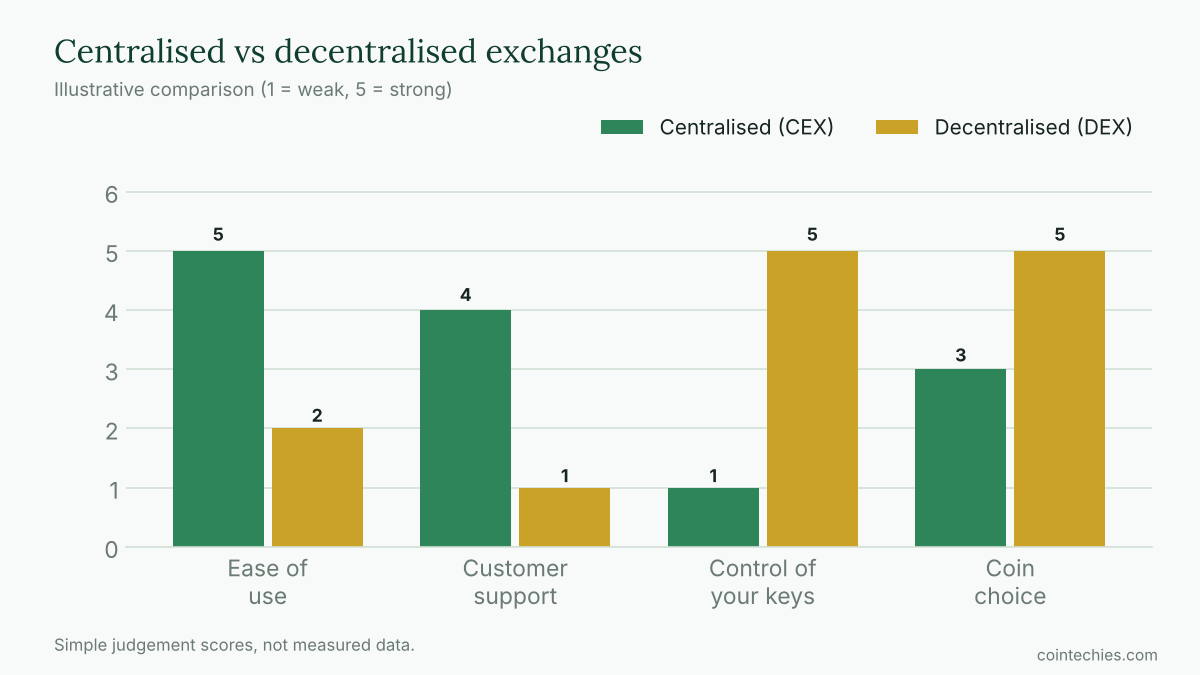
- Custody: a CEX holds your coins; on a DEX, you do.
- Identity: a CEX asks for ID; a DEX typically does not.
- Payment: a CEX accepts bank transfers and cards; a DEX needs crypto already in a wallet.
- Fees: a CEX charges trading fees; a DEX charges network fees and pool fees.
- Risk type: company failure on a CEX versus smart contract bugs and scams on a DEX.
Which should you choose?
For your first purchase with regular money, a regulated centralised exchange is usually the easiest and safest route. Once you are comfortable with wallets and security, a DEX becomes a useful tool for tokens that aren’t listed elsewhere.
Many experienced users do both: they buy on a CEX, withdraw to their own wallet and use a DEX when needed.
Safety tips for both
- Turn on two-factor authentication.
- Double-check web addresses before connecting a wallet.
- Start with small amounts.
- Avoid leaving large long-term holdings on an exchange.
- Be careful with tokens you do not recognise.
The bottom line
Centralised exchanges trade simplicity for custody. Decentralised exchanges trade convenience for control. Neither is perfect, and the best choice depends on your experience and how much responsibility you want.
This article is for educational purposes only and is not financial advice. Crypto assets are volatile and you can lose some or all of your investment.

Laisser un commentaire