Where you keep your crypto matters. Wallets come in two main types: software wallets, which run on your phone or computer, and hardware wallets, which are dedicated devices. Each has its place.
In this article
Software wallets
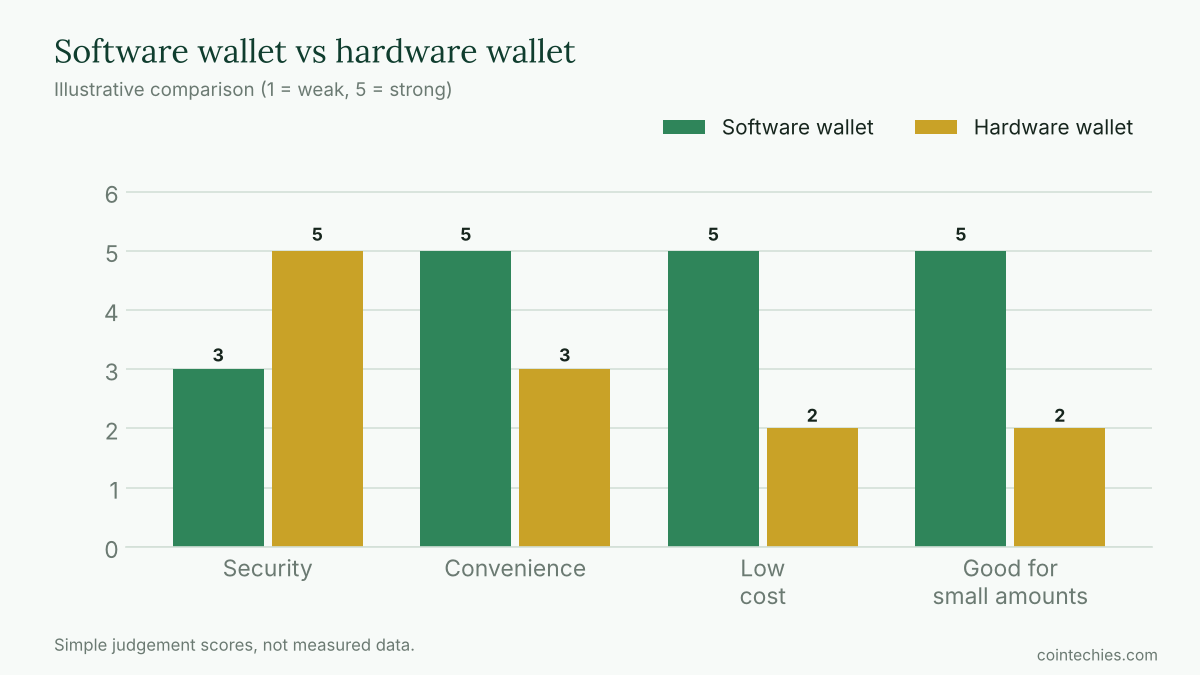
These are apps or browser extensions such as mobile wallets and desktop wallets. They store your private keys on a device that is connected to the internet, so they are also called hot wallets.
Strengths: free or cheap, quick to set up, handy for everyday use and decentralised apps.
Weaknesses: exposed to malware, phishing, device theft and fake apps. If your phone or computer is compromised, so are your keys.
Hardware wallets
A hardware wallet is a small device that stores keys offline and signs transactions internally. Even if your computer has malware, the key can’t be extracted.
Strengths: much stronger protection against online attacks, a screen to verify transactions and suited to long-term storage.
Weaknesses: a cost, typically $60 to $250, a bit slower to use and the need to protect both the device and the seed phrase.
The seed phrase applies to both
In both cases, a recovery phrase backs up the wallet. Whoever has it controls the coins. A hardware wallet does not remove the need to store it safely.
A useful analogy
A software wallet is like the cash in your pocket: handy for spending but you wouldn’t carry your life savings in it. A hardware wallet is like a safe: less convenient, but built to protect what matters most.
How to choose
- Small amounts, frequent use, learning: a reputable software wallet is fine.
- Larger or long-term holdings: a hardware wallet is strongly recommended.
- Active DeFi users: a hardware wallet connected through a software interface combines both.
A common setup
Many people keep a small amount in a mobile wallet for daily activity and the bulk in a hardware wallet. Some also use a separate wallet just for risky apps, so a mistake there cannot reach their savings.
Software wallet tips
- Download only from official sources.
- Keep the device updated.
- Don’t screenshot the seed phrase.
- Check each transaction before approving.
The bottom line
Use software wallets for convenience and small balances, hardware wallets for protecting meaningful savings. Choosing the right tool for each purpose is the heart of good crypto security.
This article is for educational purposes only and is not financial advice. Crypto assets are volatile and you can lose some or all of your investment.



Laisser un commentaire