Anyone who has used Ethereum has probably felt the sting of gas fees. One day a transfer costs pennies; the next, a swap costs more than the amount you’re trading. Why such wild swings?
The answer is a mix of limited space and a bidding system. Let’s break it down.
In this article
What gas actually is
Gas measures the computing effort needed to do something on Ethereum. Sending ETH is simple and needs little gas. Swapping tokens on an exchange or minting an NFT involves more steps, so it needs more.
The fee you pay is gas used multiplied by the price per unit of gas, quoted in gwei, a tiny fraction of an ETH. So a complicated action at a high gas price costs a lot.
The base fee and the tip
Since an upgrade in 2021, called EIP-1559, each transaction pays two parts. The base fee is set by the network depending on how full recent blocks were, and it is burned, meaning destroyed. The priority fee, or tip, goes to the validator and encourages them to include your transaction quickly.
If blocks are more than half full, the base fee rises. If they’re emptier, it falls. This adjusts every block, around every 12 seconds.
Why fees spike
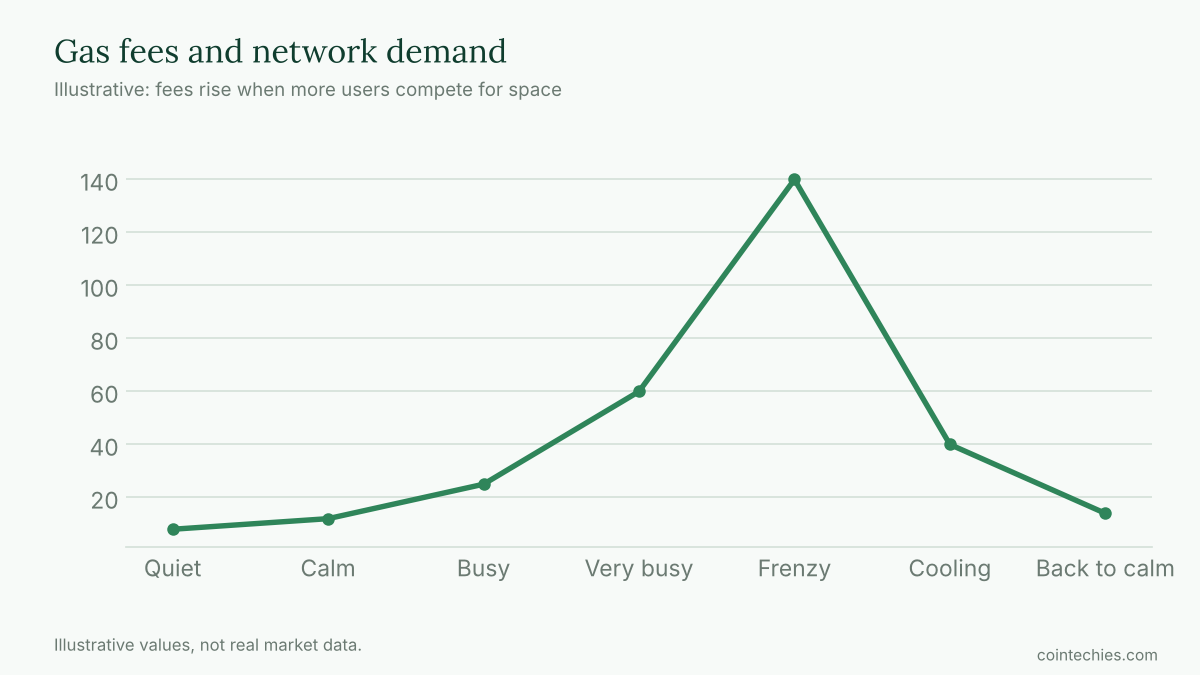
Blocks have limited room. When many people want to transact at once, they compete, and the base fee climbs. Typical triggers include popular NFT mints, token launches, sudden market crashes where everyone moves funds and busy trading days.
Ways to pay less
- Use a Layer 2 network: these networks bundle transactions and often cost a few cents.
- Choose quiet times: weekends and off-peak hours tend to be cheaper in many time zones.
- Set your own limits: wallets let you adjust the fee and wait for a cheaper moment.
- Batch your actions: combine steps where an app allows it.
- Avoid unnecessary approvals: each approval is a transaction with its own fee.
Failed transactions still cost
If a transaction fails because the price moved or the contract rejected it, you still pay for the computing used. Set sensible slippage and double-check details before confirming.
Why not just make fees cheaper?
Making the base chain bigger would raise hardware demands for validators, which could hurt decentralisation. Ethereum’s strategy is to keep the base layer lean and let Layer 2 networks handle volume. Upgrades such as the 2024 Dencun update introduced cheaper data storage for these networks, lowering their costs.
The bottom line
Gas fees are the price of scarce block space on a busy shared computer. They rise when demand surges and fall when it cools. For most everyday activity, Layer 2 networks are the practical answer, while the main chain suits larger or high-security transfers.
This article is for educational purposes only and is not financial advice. Crypto assets are volatile and you can lose some or all of your investment.

Laisser un commentaire