
Of all the questions people ask about Bitcoin, « how much should I put in? » is the one with the most practical impact and the fewest satisfying answers. Ask ten experts and you’ll hear ten numbers, from « just a tiny bit » to « as much as you can ».
The truth is that there’s no universal figure. What suits a twenty-five-year-old with no dependants and a high income can be reckless for a sixty-year-old planning to retire in three years. But that doesn’t mean we’re helpless. There are sensible frameworks, common ranges and a simple stress test that can narrow the answer to something that fits your life.
By the end of this article you’ll have a method to arrive at your own number, and you’ll understand why getting the size right matters more than getting the timing right.
In this article
Why position size matters more than timing
Most beginners obsess over when to buy. Professionals obsess over how much. There’s a good reason.
Imagine you invest at a terrible moment and Bitcoin falls 60%. If you’ve put in 2% of your savings, you’ve lost 1.2% of your total wealth. It’s annoying, and you’ll recover. If you’ve put in 60% of your savings, you’ve lost 36% of your total wealth, which can change your life.
The same logic applies in the good direction, but it’s asymmetrical. Because Bitcoin is so volatile, a small position can still deliver a meaningful boost if it does well, while limiting the damage if it doesn’t. Size is your seatbelt.
Common rules of thumb
Financial professionals who discuss crypto allocations tend to suggest relatively small percentages. You’ll often see ranges like these.
- 1% to 3%: a small « toe in the water » position for conservative investors.
- 3% to 5%: a moderate allocation that can still matter if Bitcoin performs well.
These numbers are percentages of your total investable wealth, not just your monthly savings. They’re guides, not rules.
Some large institutions have published research suggesting that holdings of a few percent in a diversified portfolio could improve returns relative to risk, because Bitcoin doesn’t always move with stocks and bonds. Others warn the benefit shrinks if it starts moving in lockstep with equities. Both views are reasonable, and neither is a promise.
The stress test: what would a crash do to you?
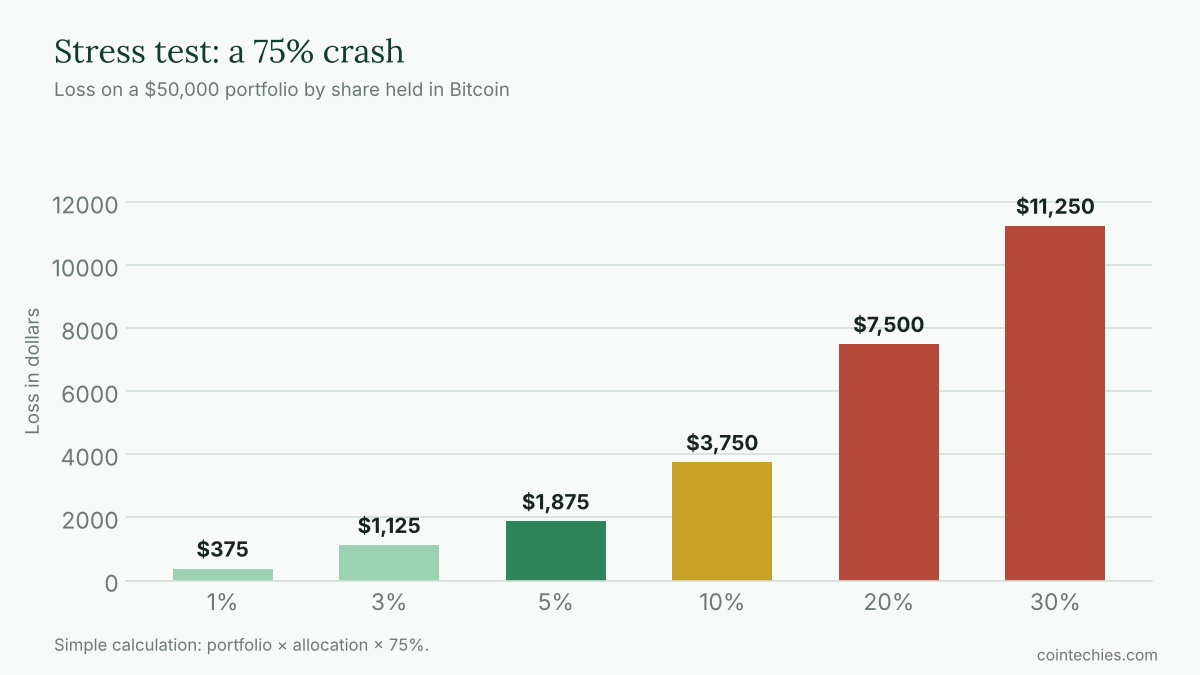
Rules of thumb are useful, but numbers become real when you see them. Let’s run a simple experiment. Imagine a portfolio worth $50,000 and ask what happens if Bitcoin falls 75%, a drop it has experienced several times.
At a 1% allocation, the portfolio loses around $375. That’s a bad week, not a catastrophe. At 10%, it loses $3,750. At 30%, it loses more than $11,000, and the rest of your portfolio would need to work hard to make up for it.
Now ask yourself the crucial question: at which point would I start feeling genuinely uncomfortable, even if it’s « only paper »? Whatever number you pick, that’s your ceiling. Your plan should stay comfortably below it.
Match your allocation to your profile
Let’s make this concrete with three imaginary investors. Their details are invented, but the thinking applies broadly.
Emma, 28, early career
Emma earns a steady salary, has an emergency fund and no debt. She invests monthly and won’t need the money for 20-plus years. She can handle high volatility because she has time to recover and add to her investments.
A reasonable range: around 5% to 10% of her investments in Bitcoin, built gradually with monthly purchases. She might choose the lower end if she has student loans or worries about job security.
Marc, 45, with a family
Marc has a mortgage, two children and a retirement plan he wants to stay on track. A big loss would affect his family’s stability, but he also wants some growth.
A reasonable range: around 2% to 5%. It’s enough to matter if Bitcoin does well, yet small enough that a crash won’t disturb his big commitments.
Linda, 62, approaching retirement
Linda plans to retire in three years and will rely on her portfolio. She has little time to recover from a major drop.
A reasonable range: 0% to 2%, if at all. For someone close to retirement, stability tends to matter more than upside. If she holds any, it should be an amount she’s happy to lose.
These ranges aren’t prescriptions. They show how time horizon, obligations and flexibility push the number up or down.
The bottom line
There is no magic number for how much Bitcoin to hold. For most people, a small slice, often between 1% and 5% of investable wealth, strikes a sensible balance between participating in a potentially important asset and avoiding financial damage if things go wrong. Younger investors with stable finances might stretch higher. People close to needing their money should usually go lower or skip it.
The best amount is the one that lets you stay calm, keep investing and avoid selling at the worst moment. If you pick a size that survives a crash, you give yourself the chance to benefit from the upside.
Keep reading: check whether Bitcoin is still worth buying in 2026 or how to start investing in cryptocurrency.
This article is for educational purposes only and is not financial advice. The ranges and examples are illustrations, not recommendations for your situation. Consider speaking to a qualified adviser. You can lose some or all of the money you invest in crypto assets.