Starting with crypto can feel like walking into a foreign airport at night. The signs use strange words, everyone seems to know where they’re going and a few people are definitely trying to sell you something.
Take a breath. Investing in cryptocurrency is not as complicated as the jargon makes it sound, and you don’t need to be a programmer or a financial wizard. What you do need is a clear plan, a handful of good habits and a healthy suspicion of anything that promises easy money.
This guide takes you from zero to your first purchase, step by step. We’ll cover how to decide whether crypto belongs in your finances, where to buy, how to keep your coins safe and which mistakes catch most newcomers. Grab a coffee and let’s go.
In this article
Step 1: Choose where to buy
Most beginners buy through a cryptocurrency exchange, a platform where you swap regular money for crypto. Choosing a good one is your first big decision. Here’s what to look for.
1. Regulation and reputation. Prefer exchanges that are licensed or registered in your country or region, with a long public track record. Search for the company’s history, and check whether it has ever lost customer funds.
2. Security features. Two-factor authentication, withdrawal whitelists and clear information about how customer assets are held are all good signs.
3. Fees. Exchanges charge trading fees, and sometimes extra for deposits, withdrawals or using a debit card. Card purchases are usually the most expensive way to buy; bank transfers are generally cheaper.
4. Ease of use. A clean, simple interface for beginners makes mistakes less likely. Many platforms offer a basic « buy » screen and an advanced trading screen. Start with the basic one.
5. Customer support. Check that you can actually reach a human if something goes wrong.
6. Supported payment methods. Make sure you can deposit using a method you trust, such as a bank transfer.
Be wary of apps promoted by influencers with referral bonuses, or any platform that promises guaranteed returns. If a website sounds too good to be true, close the tab.
Step 2: Create and secure your account
Once you’ve picked a platform, it’s time to sign up. You’ll go through a verification process known as KYC, which stands for « know your customer ». You’ll upload ID and sometimes a selfie. It may feel invasive, but it’s a sign the platform follows the rules.
Right away, do the following:
- Use a unique, long password stored in a password manager. Never reuse a password from another site.
- Turn on two-factor authentication using an authenticator app rather than text messages, which can be hijacked through SIM-swapping.
- Set up an anti-phishing code if the exchange offers it, so you can recognise genuine emails.
- Create a separate email address just for crypto, if you can.
Spending twenty minutes on this now can save you from a lot of pain later. Most stolen accounts were not hacked by geniuses; they were tricked or had weak passwords.
Step 3: Start small and build the habit
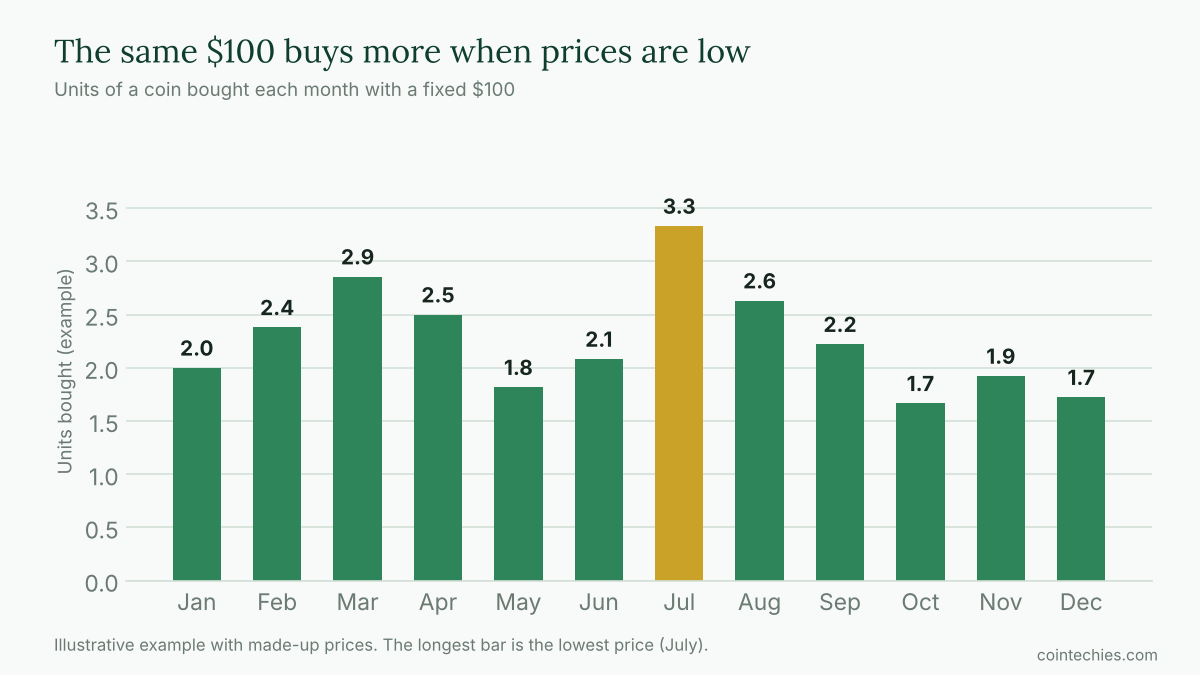
A common beginner trap is putting in a big lump sum all at once, then panicking at the first dip. A calmer approach is dollar-cost averaging, usually abbreviated to DCA. You invest a fixed amount on a regular schedule, for example every month, regardless of price.
DCA has a few clear benefits for beginners:
- You never need to guess the « right » moment to buy.
- Your average purchase price smooths out over time.
- You turn investing into a routine, which keeps emotions in check.
It doesn’t remove the risk of loss, and it doesn’t guarantee profit, but it keeps you in the game without needing to be a market timer. Many exchanges let you automate recurring buys.
Step 4: Know the scams
Crypto attracts criminals because transactions can’t be reversed. Learn the common tricks.
- Giveaway scams. « Send 1 coin and get 2 back. » Nobody gives away free crypto.
- Fake support. Someone messages you offering help with a problem. Real support doesn’t approach you first.
- Phishing sites. Copycat websites and emails that look like your exchange. Always type the address yourself or use a bookmark.
- Romance and « pig butchering » scams. A friendly stranger gradually persuades you to invest in a fake platform.
- Guaranteed returns. Any promise of fixed, high, risk-free profits is a red flag.
A simple rule protects you from most of these: never send crypto to anyone you don’t know, and never click links you didn’t ask for.
Ready for the next step? Read how much money to put in with how much money you should invest in Bitcoin, weigh trading against long-term investing and check the 10 common beginner mistakes. You can also browse our live prices page.
The bottom line
Investing in crypto as a beginner is mostly about doing simple things well: prepare your finances, learn the basics, pick a trustworthy platform, secure your account, start small and be consistent. The glamorous parts of crypto, like chasing the next hot coin, are usually where beginners get burned.
If you treat your first year as a learning period rather than a race to get rich, you’ll be in a much stronger position, whatever the market does.
This article is for educational purposes only and is not financial advice. Crypto assets are volatile and you can lose some or all of your investment. Check the rules and taxes that apply in your country.