Stablecoins began as a way to park money between crypto trades. Now they are increasingly used to pay for real things: salaries, supplier invoices, online purchases and family remittances. Here is where the trend stands.
In this article
Why use a stablecoin to pay?
- Speed: transfers settle in seconds or minutes, any day of the week.
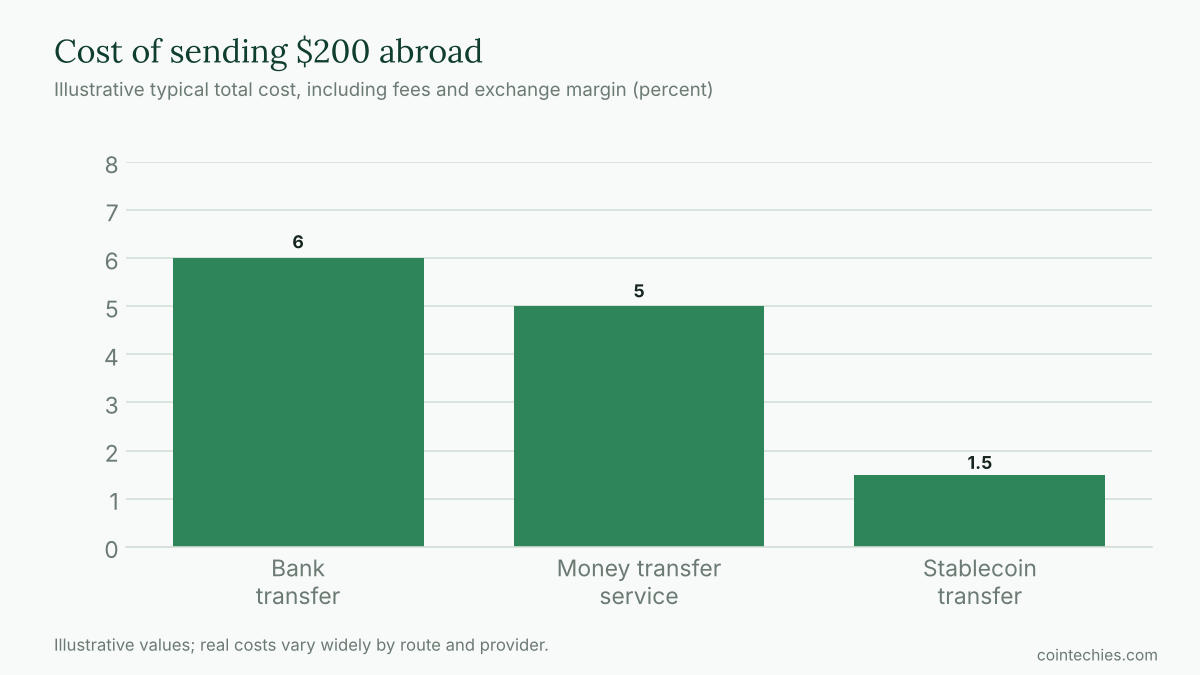
- Cost: fees can be low, particularly on cheaper networks.
- Reach: anyone with a phone and a wallet can receive dollars, even without a bank account.
- Programmability: payments can be automated through smart contracts.
- Stable value: unlike Bitcoin, the price does not swing wildly.
Main use cases
Cross-border payments and remittances. Workers sending money home can avoid high fees and slow transfers, and recipients may cash out locally.
Business payments. Companies pay suppliers or contractors abroad, and treasury teams move money between countries outside banking hours.
Salaries for freelancers. Remote workers and online platforms increasingly offer stablecoin payouts.
Savings in unstable economies. In countries with high inflation or currency controls, a dollar-linked token acts as a store of value.
Who is building it
Payment firms, card networks, fintech apps and banks have launched or tested stablecoin products. Merchants can accept stablecoin payments through processors that convert them to local currency instantly, so they never touch crypto.
Remaining hurdles
- On- and off-ramps: turning local money into stablecoins and back can carry fees and friction.
- Regulation: rules differ by country, and compliance requirements such as the travel rule apply.
- Consumer protection: payments are not reversible, so errors and fraud are harder to fix.
- Issuer risk: reserves and redemption rights matter.
- User experience: wallets and networks can confuse newcomers.
- Tax and accounting: each payment can be a reportable event in some places.
Regulation as an accelerator
New laws, including the US stablecoin law passed in 2025 and the EU’s MiCA, give issuers clearer rules and make banks and businesses more comfortable. This is a major reason behind growing interest from traditional finance.
Tips if you want to try it
- Use well-known stablecoins and regulated services.
- Double-check the network and address before sending.
- Start with a small test payment.
- Keep records for tax.
The bottom line
Stablecoins are becoming practical payment tools, especially for cross-border transfers. They are fast and cheap, but still depend on good on- and off-ramps, clear rules and careful use.
This article is for educational purposes only and is not financial advice. Stablecoins can lose their peg and payments cannot be reversed. Crypto assets are volatile and you can lose some or all of your investment.



Laisser un commentaire