A ledger is simply a record of transactions, like a bank’s books. For centuries, one organisation kept the ledger and everyone trusted it. A distributed ledger changes that: the same record is stored and updated across many computers at once.
In this article
Centralised vs distributed
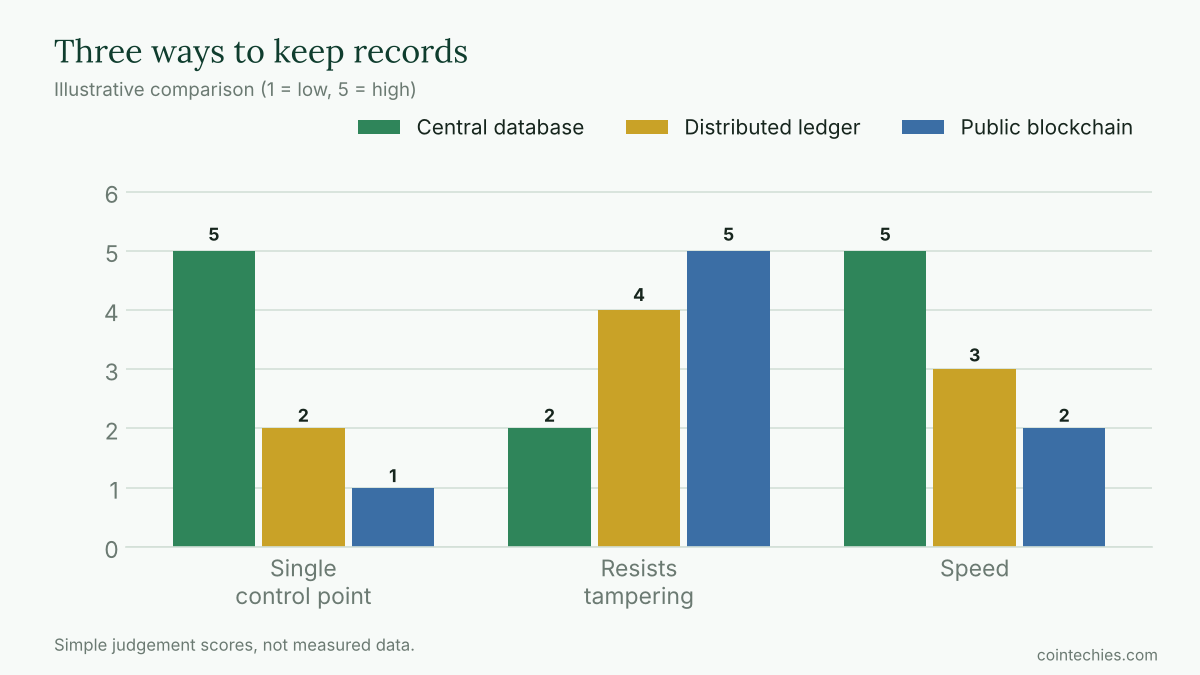
In a centralised system, a single party controls the database. It is fast and simple, but if that party makes an error, is hacked or acts dishonestly, everyone relies on its word.
In a distributed system, many participants each hold a copy, and updates are only accepted when the group agrees on them. There’s no single point of failure and no single owner of the truth.
Distributed ledger technology (DLT)
DLT is the general term for systems that keep a synchronised record across multiple locations. The main ingredients are:
- Copies of the data held by many nodes.
- Rules for updating the record, such as consensus.
- Cryptography to secure and verify entries.
Is every distributed ledger a blockchain?
No. A blockchain is one type of distributed ledger, in which data is grouped into blocks linked in a chain. Others use different structures. For example, Hedera uses a directed graph called hashgraph, and IOTA uses a structure called the Tangle. Many enterprise systems use ledgers that don’t package data in blocks at all.
Public and permissioned ledgers
- Public ledgers, such as Bitcoin and Ethereum, are open: anyone can read the data and take part.
- Permissioned ledgers, such as those used by banks and supply-chain consortia, restrict who can join and write. They are faster and more private, but less open.
Where distributed ledgers are used
- Payments and settlement: banks test shared ledgers to settle transactions faster.
- Supply chains: tracking goods between companies that don’t fully trust each other.
- Identity and records: certificates, titles and credentials that must not be altered.
- Trade finance: reducing paperwork between many parties.
Do you need one?
A ledger shared by many parties only makes sense when trust between them is a real problem. If a single organisation can run the database, a normal database is cheaper, faster and simpler. Many blockchain projects have failed because they solved a problem that did not exist.
The bottom line
A distributed ledger is a record shared and synchronised across many computers, with no single owner. Blockchains are the best-known kind, but the idea is broader, and its value depends on whether shared trust is genuinely needed.
This article is for educational purposes only and is not financial advice. Crypto assets are volatile and you can lose some or all of your investment.
Laisser un commentaire