Before MiCA, each EU country had its own approach to crypto, which confused companies and investors. The Markets in Crypto-Assets Regulation, known as MiCA, creates a single set of rules across the whole bloc.
In this article
What is MiCA?
MiCA is an EU regulation, which means it applies directly in all member states. Its rules for stablecoins began applying in mid-2024, and the full regime for crypto service providers began at the end of 2024.
Its goals are consumer protection, market integrity, financial stability and a clear framework that lets compliant firms operate across the EU with one licence.
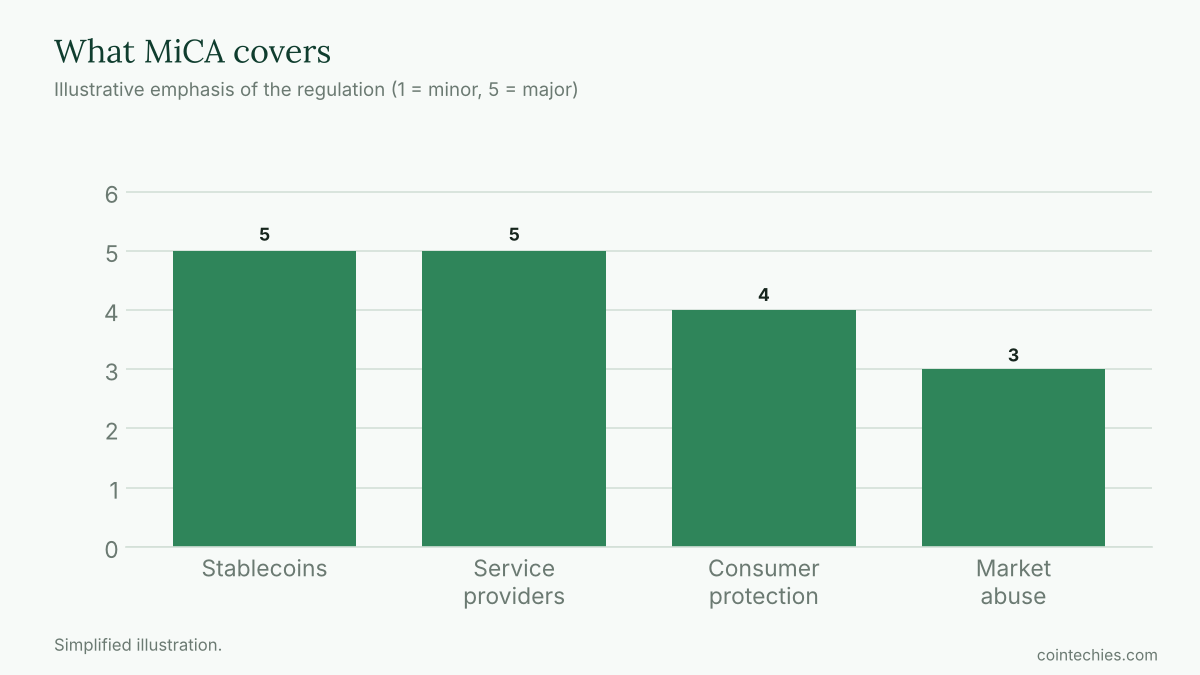
Who and what does it cover?
- Crypto-asset service providers (CASPs): exchanges, custodians, brokers and advisers must be authorised and meet requirements on capital, governance, security and conflicts of interest.
- Issuers of crypto-assets: most must publish a white paper with clear information, and are responsible for it.
- Stablecoins: two types are covered: e-money tokens, tied to a single currency, and asset-referenced tokens, backed by a basket. Issuers must hold reserves and meet strict rules.
What is outside MiCA?
Fully decentralised services with no identifiable operator, NFTs that are truly unique, and central bank digital currencies are generally excluded, although the lines can be blurry. Crypto that counts as a financial instrument falls under existing securities laws instead.
Passporting
An authorised firm in one member state can offer services across the EU. This should reduce fragmentation and make it easier for companies to compete, while giving users consistent protection.
What it means for investors
- More transparency: white papers and clearer disclosures.
- Safer custody: providers must segregate client assets and protect them.
- Stablecoin rules: issuers need reserves and redemption rights.
- Fewer unlicensed platforms: some services have changed or left the market.
- Complaint handling: firms must have procedures, giving users recourse.
Related rules
The Transfer of Funds Regulation, often called the travel rule, requires crypto firms to collect and share sender and recipient information on transfers. Anti-money-laundering rules also apply.
Taxes are separate
MiCA doesn’t set tax. Each member state decides how to tax crypto.
The bottom line
MiCA gives the EU one of the most comprehensive crypto frameworks in the world. For users, it means licensed providers, better disclosure and safer stablecoins. Always check that your platform is authorised in the EU.
This article is for educational purposes only and is not legal, tax or financial advice. Rules change, so check official sources. Crypto assets are volatile and you can lose some or all of your investment.



Laisser un commentaire