The United States doesn’t have a single crypto law that covers everything. Instead, several agencies oversee different parts of the market, using older laws applied to a new technology. That makes it a complicated picture.
In this article
The main regulators
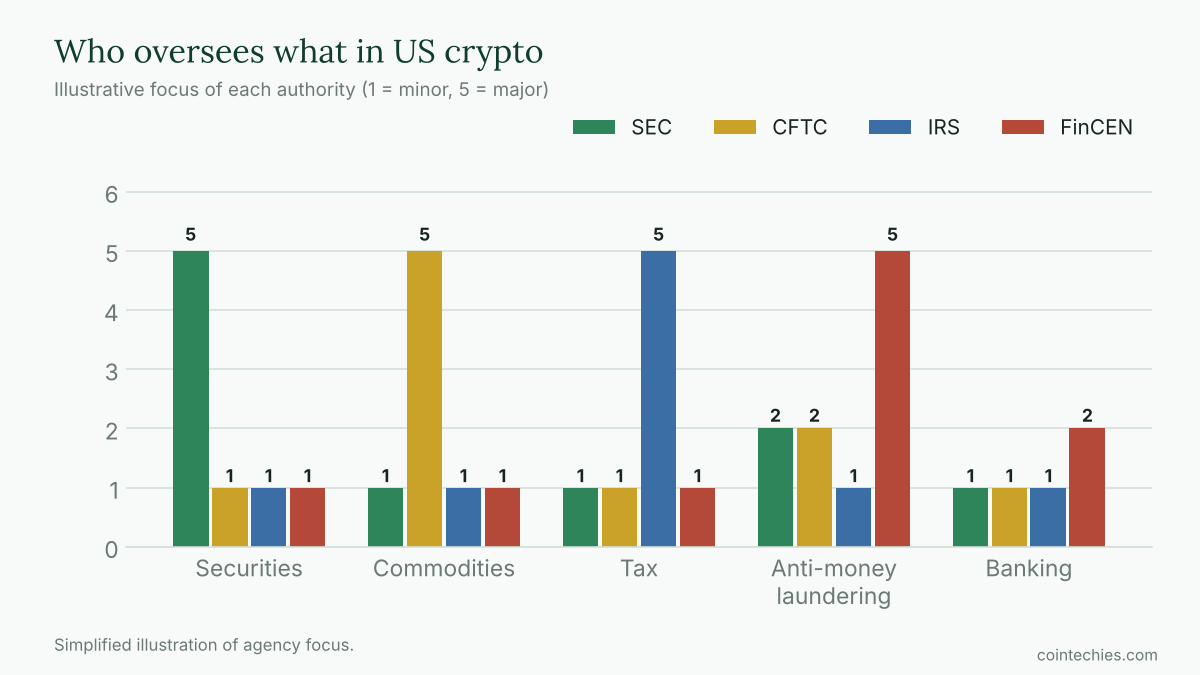
- SEC (Securities and Exchange Commission): oversees securities. It has argued that many tokens sold to raise money are securities and must follow disclosure rules.
- CFTC (Commodity Futures Trading Commission): oversees commodities and derivatives. It regards Bitcoin and Ether as commodities and polices derivatives markets and fraud.
- IRS (Internal Revenue Service): treats crypto as property for tax. Selling, swapping or spending it can trigger taxes.
- FinCEN: enforces anti-money-laundering rules on money services businesses, including many crypto platforms.
- Banking regulators and the Treasury: oversee how banks interact with crypto and enforce sanctions.
- States: many have their own licences, such as New York’s BitLicense.
The securities debate
A key question is which tokens count as securities. US regulators have often relied on the Howey test, from a 1946 Supreme Court case, which asks whether people invest money in a common enterprise expecting profit from the efforts of others. This has led to lawsuits against exchanges and token issuers, and years of debate about whether clearer rules are needed.
Recent developments
In January 2024, regulators approved spot Bitcoin ETFs, followed by Ether ETFs later that year. In 2025, the US passed the GENIUS Act, creating a federal framework for payment stablecoins. Policy has also shifted toward clearer rules for the wider market, though the details continue to evolve, so check current sources.
What it means for you
- Use registered platforms: choose exchanges that are licensed and compliant.
- Expect KYC: you’ll need to verify your identity.
- Taxes: report crypto income and gains. Exchanges send forms and report to the IRS in many cases.
- Product availability: some tokens or services may be unavailable in certain states.
Consumer protections
Crypto held on an exchange is not covered by deposit insurance like bank accounts. Understand where your assets are and what protections apply.
What to watch
Congress has considered legislation on market structure, defining roles for the SEC and CFTC. Court decisions and agency guidance also shape the rules. Following official announcements helps you stay up to date.
The bottom line
US crypto regulation is a patchwork of agencies and laws that is gradually becoming clearer. For individuals, the practical steps are the same: use compliant platforms, keep records and pay your taxes.
This article is for educational purposes only and is not legal, tax or financial advice. Rules change, so check official sources. Crypto assets are volatile and you can lose some or all of your investment.



Laisser un commentaire