Short answer: in most countries, owning cryptocurrency is legal. But the details vary, and rules keep evolving. This is a broad overview, not legal advice, so always check the rules where you live.
In this article
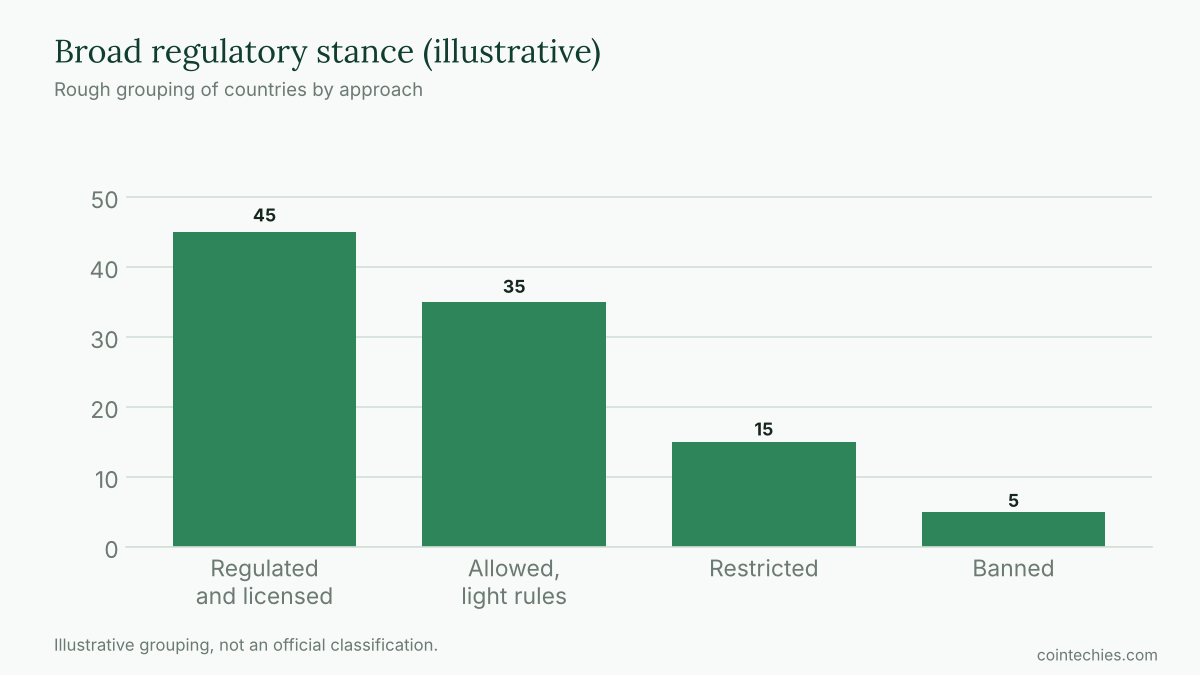
Three common approaches
Regulated and licensed. Many large economies allow crypto and require exchanges and service providers to register, follow anti-money-laundering rules and protect customers. This includes the European Union, the United Kingdom, Japan, Singapore, and, with a mix of federal and state oversight, the United States.
Allowed with light rules. Some countries allow trading and ownership but have limited specific legislation, or are still drafting it.
Restricted or banned. A few countries ban or heavily restrict crypto. China, for instance, prohibits crypto trading and mining on the mainland, while still exploring its own digital currency.
Regions at a glance
- United States: crypto is legal. The SEC, the CFTC and other agencies share oversight, and the IRS treats crypto as property for tax. A federal law on stablecoins was passed in 2025.
- European Union: the MiCA regulation creates a common licensing and consumer protection framework for crypto service providers.
- United Kingdom: legal to own. Providers must register with the Financial Conduct Authority, and promotions face strict rules.
- Japan and Singapore: licensing regimes for exchanges and strict customer protection.
- UAE: developed licensing, notably in Dubai and Abu Dhabi, attracting crypto firms.
- India: legal but heavily taxed, and regulation remains uncertain.
- El Salvador: adopted Bitcoin as legal tender in 2021, with later changes under an agreement with the IMF.
Legal does not mean risk-free
Even where crypto is legal, rules cover taxes, reporting, advertising and who can sell what to whom. Some services may be unavailable in your country.
Why rules differ
Governments weigh consumer protection, financial stability, crime prevention, tax revenue and innovation. Some see crypto as a threat to monetary control, others as an industry to attract.
How to check your own situation
- Visit your country’s financial regulator and tax authority websites.
- Use exchanges that are licensed in your jurisdiction.
- Keep records of every transaction.
- Consider professional advice for larger amounts.
The bottom line
Crypto is legal in most major economies, but regulation is a moving target. Stay informed through official sources and use compliant platforms.
This article is for educational purposes only and is not legal, tax or financial advice. Rules change, so check official sources for your country. Crypto assets are volatile and you can lose some or all of your investment.



Laisser un commentaire