Bitcoin vs Ethereum: Which Cryptocurrency Is a Better Long-Term Investment?
Bitcoin and Ethereum are the two largest cryptocurrencies, and the first two names most newcomers consider. They are often compared as if they were rivals, yet they were built to do different things. Choosing between them is less about picking a winner and more about understanding what each one is, what could go wrong and how much risk you are willing to take. This guide compares them across supply, security, use cases and risk, so you can think clearly about long-term exposure.
Two different ideas
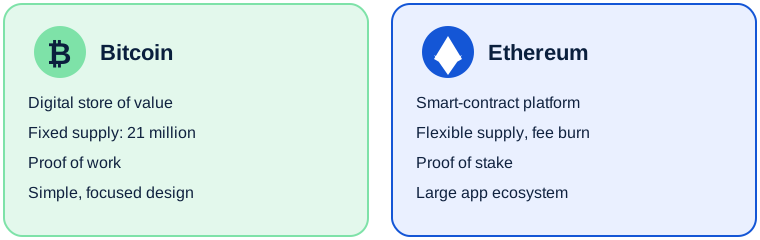
Bitcoin launched in 2009 as a peer-to-peer electronic cash system. Over time its role has shifted: many investors see it as a scarce digital store of value, sometimes compared with digital gold. Its design is deliberately simple and conservative. Changes to the protocol are rare and slow.
Ethereum launched in 2015 with a broader goal: to be a programmable blockchain. Developers can deploy smart contracts, which are programs that run on the network. This powers decentralized finance, stablecoins, tokenized assets and many other applications. Its native coin, ether (ETH), is used to pay fees and to secure the network through staking.
Supply and monetary policy
Bitcoin has a fixed maximum supply of 21 million coins. New coins are created at a rate that is cut roughly every four years in an event called the halving. This predictable scarcity is central to the Bitcoin investment case.
Ethereum has no fixed cap. New ether is issued to reward validators, but since an upgrade known as EIP-1559, part of the transaction fees is burned. Depending on network activity, the supply can grow slowly or even shrink. Ethereum’s monetary policy is therefore more flexible and more dependent on how much the network is used.
Security and consensus
Bitcoin uses proof of work: miners spend computing power and energy to add blocks. After more than a decade, this model has proven very resilient, though it consumes a lot of electricity.
Ethereum moved from proof of work to proof of stake in 2022. Validators lock up ETH as collateral and can be penalized for misbehavior. This uses far less energy and lets holders earn staking rewards, but it also introduces different trade-offs, such as questions about concentration among large staking providers.
Use cases and ecosystem
Bitcoin’s ecosystem is focused: holding, transferring and, increasingly, using it as a reserve asset. Additional layers exist on top of Bitcoin, but the base network remains intentionally limited.
Ethereum hosts a vast ecosystem: lending and trading protocols, stablecoins, games, identity tools and many other applications. Much of this activity also runs on “layer 2” networks that settle back to Ethereum to lower costs. The upside is a large base of developers and users. The downside is complexity, and the risk that competing networks attract users and developers away.
The risks of each
Bitcoin risks. Its value depends largely on continued belief in its role as a store of value. Regulation, shifts in investor sentiment or technological threats could affect it. Because it has fewer new use cases, its price is closely tied to market sentiment.
Ethereum risks. Its value depends on real usage and on competitive standing. Technical upgrades are complex, smart-contract bugs in the ecosystem can make headlines, and rival platforms compete for the same developers. Regulatory treatment of staking and tokens may also affect it.
Risks common to both. Both can fall by half or more within months, as they have in the past. Both can be affected by exchange failures, hacks, regulation and market panics. Neither is guaranteed to rise over the long term.
Side-by-side comparison
| Criteria | Bitcoin (BTC) | Ethereum (ETH) |
|---|---|---|
| Main role | Digital store of value | Smart-contract platform |
| Supply | Fixed at 21 million | No fixed cap, fee burn |
| Consensus | Proof of work | Proof of stake |
| Staking rewards | Not on the base network | Yes, variable |
| Ecosystem | Focused and simple | Broad and fast-moving |
| Main risk | Sentiment and role | Competition and complexity |
Volatility and position sizing
Whichever asset you choose, volatility is the main practical challenge. Many investors manage it with a few simple habits. They only invest money they could lose without harming their finances. They spread purchases over time instead of buying all at once, a method often called dollar-cost averaging. And they decide in advance how much of their total savings crypto should represent, rather than letting price moves decide for them.
Because the two assets behave differently but still tend to move together during market stress, holding both does not remove risk. It simply spreads your exposure across two different theses.
So, which is the better long-term investment?
There is no universal answer. Investors who value scarcity, simplicity and a long track record tend to lean towards Bitcoin. Investors who believe in the growth of decentralized applications, and who are comfortable with more moving parts, may prefer Ethereum. Many hold both, in proportions that match their conviction and their risk tolerance.
Whatever you decide, a sound approach rests on three questions. Do you understand what you are buying? Could you live with a large drop? And is this a small part of a well-diversified financial life?
What price history can and cannot teach us
Both assets have gone through several dramatic cycles: long rallies followed by drops of 50% or more, sometimes lasting more than a year. Investors who bought near a peak and sold in a panic often locked in large losses, while those who could hold through the downturns had a very different experience. That does not mean prices will always recover. It means that holding crypto requires the financial and emotional ability to sit through severe declines.
Historical charts are useful to understand volatility, not to predict the future. A strategy that relies on “it always came back before” is not a strategy.
Institutions, funds and regulation
In recent years, large financial institutions have shown more interest in both assets. Regulated investment products tied to Bitcoin, and later to ether, have been approved in some major markets, which makes access easier for traditional investors. Greater institutional involvement can bring more liquidity and legitimacy, but it can also increase correlation with traditional markets and make prices react to macroeconomic news.
Regulation remains a major variable. Rules on trading, custody, staking and taxation differ by country and keep changing, so check what applies where you live.
Building a long-term plan
A plan matters more than a prediction. A reasonable framework might include the following steps:
- Set a budget. Decide the maximum share of your savings you are willing to expose to crypto, and keep an emergency fund outside it.
- Define your horizon. If you may need the money within a few years, crypto is probably the wrong tool.
- Choose your allocation. Decide in advance how you will split between Bitcoin, Ethereum and anything else, and why.
- Invest gradually. Regular purchases reduce the risk of buying everything at a bad moment.
- Secure your assets. Use strong, unique passwords, two-factor authentication and, for larger amounts, a hardware wallet.
- Review periodically. Rebalance or adjust when your situation changes, not when headlines scare you.
Mistakes to avoid
- Investing money you cannot afford to lose, especially borrowed money.
- Buying because of social media hype or fear of missing out.
- Putting everything into one asset because someone online called it a sure thing.
- Leaving large amounts on an exchange without understanding the custody risk.
- Trusting anyone who guarantees returns. No honest provider can.
Questions to ask yourself before buying either one
- Can I explain in two sentences why I want this asset? If not, keep learning before investing.
- What would I do if the price fell by half next month? Your honest answer reveals your real risk tolerance.
- Do I understand how I will store it? Self-custody gives control but also responsibility, while exchanges add counterparty risk.
- Is my time horizon long enough? Both assets can stay below previous highs for long periods.
- Am I comparing with simpler alternatives? Savings accounts, index funds and bonds carry very different risks and may suit some goals better.
Answering these questions in writing, before you invest, makes it much easier to stay calm and consistent when markets become emotional.
Key takeaways
- Bitcoin and Ethereum solve different problems and carry different risks.
- Bitcoin offers fixed scarcity and simplicity. Ethereum offers flexibility, an app ecosystem and staking rewards.
- Both are highly volatile and neither is guaranteed to rise.
- Position sizing and time diversification matter more than trying to pick a winner.
This article is for education only and is not financial advice.