Crypto Staking Explained: How to Earn Passive Income With Cryptocurrency
Staking is one of the most talked-about ways to put cryptocurrency to work. Instead of leaving coins idle in a wallet, you lock them up to help a blockchain run, and the network pays you rewards in return. It sounds simple, and in principle it is. But rewards are variable, your capital stays exposed to price swings, and several technical risks are easy to overlook. This guide explains how staking works, where the rewards come from and what to check before you start.
What is crypto staking?
Staking is the act of committing cryptocurrency to support the operation of a proof-of-stake blockchain. In a proof-of-stake network, participants called validators are chosen to propose and confirm new blocks of transactions. To earn that right, they must lock up (“stake”) a certain amount of the network’s coin as a guarantee of honest behavior.
If a validator does its job correctly, it receives rewards. If it misbehaves or is badly misconfigured, part of its stake can be destroyed in a penalty known as slashing. This mix of reward and penalty is what keeps the network secure without the heavy energy use of mining.
You do not have to run a validator yourself. Most people stake through a service or by delegating their coins to a validator, and share in the rewards.
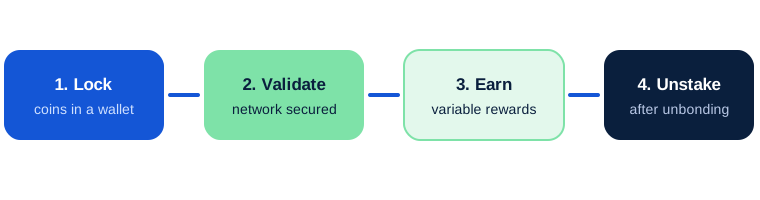
How staking works, step by step
- You acquire a stakeable coin. Examples include Ethereum, Solana, Cardano or Cosmos. Bitcoin cannot be staked on its own network because it uses proof of work.
- You choose a staking method. You can stake directly, delegate to a validator, use a pool or use a platform that does it for you.
- Your coins are locked or delegated. Depending on the network, they may be unavailable for a set period.
- The network distributes rewards. Rewards usually accrue regularly and are paid in the same coin you staked.
- You unstake. Many networks apply an unbonding period, from a few days to several weeks, before coins become available again.
Four common ways to stake
1. Solo staking. You run your own validator. This gives you full control and the best alignment with the network, but it needs technical skill, reliable hardware and, on Ethereum, a minimum of 32 ETH. Mistakes such as downtime or double-signing can be penalized.
2. Delegated staking. On networks that support it, you assign your coins to a validator while keeping custody in your own wallet. The validator takes a commission. Your main task is choosing a reliable validator.
3. Staking pools and liquid staking. Pools combine many small holders. Liquid staking protocols go one step further and give you a receipt token that represents your staked coins, which you can sometimes use elsewhere. This adds flexibility but also adds smart-contract risk and the risk that the receipt token trades below the value of the underlying coin.
4. Exchange and platform staking. Centralized platforms stake on your behalf with a few clicks. It is the easiest option, but you rely on the company: you are exposed to its security, its solvency and its terms. Fees are often higher than doing it yourself.
Where do staking rewards come from?
Rewards are not magic. They come from two main sources. The first is newly issued coins, which the protocol creates and distributes to validators. The second is transaction fees paid by users of the network. On some networks, part of the fees is burned, which changes the overall economics.
Because rewards depend on how many coins are staked in total and how busy the network is, they are not fixed. When many people stake, each participant’s share tends to shrink. A “projected yield” shown by a platform is an estimate, not a promise.
The real risks of staking
Price risk. This is the biggest one. Staking does not protect you from market declines. A decline of the coin can outweigh several months of rewards.
Lock-up and liquidity risk. If your coins are locked or subject to an unbonding period, you may be unable to sell in a falling market.
Slashing risk. If your validator misbehaves or is poorly run, a portion of the staked coins can be lost. Choose validators with a solid track record and avoid putting all your stake with a single one.
Smart-contract and protocol risk. Liquid staking and pools rely on code. Bugs and exploits can lead to losses, even in audited projects.
Counterparty risk. With a centralized platform, the company holds or controls your coins. If it fails, freezes withdrawals or is hacked, you may not get your funds back.
Regulatory risk. Rules on staking services vary by country and are still evolving. Platforms may change or withdraw services at short notice.
How to evaluate a staking opportunity
Before you stake, run through a short checklist:
- Do you believe in the asset? Only stake coins you would be comfortable holding anyway.
- What is the lock-up period? Know how long it takes to get your coins back.
- Who holds the keys? Self-custody, delegation and platforms carry very different risks.
- What are the fees? Validator commissions and platform fees reduce your net reward.
- Is the yield explained? If you cannot explain where it comes from, do not rely on it.
- How concentrated is your exposure? Avoid putting everything into a single coin, validator or platform.
Taxes and regulation
In many countries, staking rewards are treated as income when you receive them, and selling the rewards later can trigger capital gains or losses. Rules differ widely and change over time, so keep records of every reward and speak to a qualified tax adviser in your country. The same applies to regulation: check that any service you use is authorized where required.
Is staking really “passive income”?
Partly. Once set up, staking requires little day-to-day effort, which is why it feels passive. But the income is uncertain, paid in a volatile asset and tied to technical and market risks. A better way to see staking is as a modest additional return on assets you already want to hold for the long term, not as a salary and not as a guaranteed yield.
Staking versus holding versus lending
It helps to see staking next to the alternatives. Simply holding a coin gives you exposure to its price and nothing else: no rewards, no lock-up, full flexibility. Staking adds a variable reward and often a lock-up, in exchange for helping secure the network. Lending your coins to a platform or protocol earns interest paid by borrowers, but exposes you to the borrower and platform risk, which has caused serious losses for investors in the past.
These are three different risk profiles, not three versions of the same product. Staking’s risks are mostly protocol-level and technical, while lending’s risks are mostly about who you trust with your money.
A simple example (hypothetical numbers)
Imagine you stake coins worth $1,000 at a hypothetical reward rate of 4% per year, paid in the same coin. After one year you would hold coins worth about $40 more at the original price. Now imagine the coin’s price drops 30% over the same year: your position is worth roughly $728, even after rewards. If the price instead rises 30%, you hold roughly $1,352. The reward matters, but the price movement is far bigger.
This is why a high staking rate on a falling asset is not a good deal, and why a modest rate on an asset you believe in can still make sense. Always think in terms of the total outcome, not only the reward percentage.
Common mistakes beginners make
- Chasing the highest yield without understanding where it comes from.
- Staking money they may need soon, then being locked out during an emergency or a market drop.
- Using a single platform for everything, which concentrates counterparty risk.
- Ignoring fees and commissions that quietly reduce the net reward.
- Forgetting tax records, which becomes painful when many small rewards accumulate.
- Falling for scams that promise “guaranteed staking returns” or ask for your seed phrase. A legitimate service never needs your seed phrase.
Key takeaways
- Staking means locking coins to help secure a proof-of-stake network in exchange for rewards.
- Rewards come from new issuance and fees. They are variable and never guaranteed.
- The main risk is the price of the coin, followed by lock-ups, slashing, smart-contract flaws and counterparty failures.
- Choose your method deliberately, compare fees and diversify.
- Only stake what you can afford to lose, and keep good records for tax.
This article is for education only and is not financial, tax or legal advice.